Contents
Can you do it for free
You can, the only question is how often and on what terms. Almost every service that recognises food in a picture works the same way: a few analyses are free to try, and regular use needs a subscription. That isn't developers being greedy, it's that every photo analysis is work done by a large neural network on powerful servers, and the service pays for each one out of its own pocket. So the more honest question is not "where is it free" but "what exactly is free, and for how long", and below we go through how it usually works, what to look out for and how to get the most out of the free options, ours included.
Why photo analysis can't be free forever
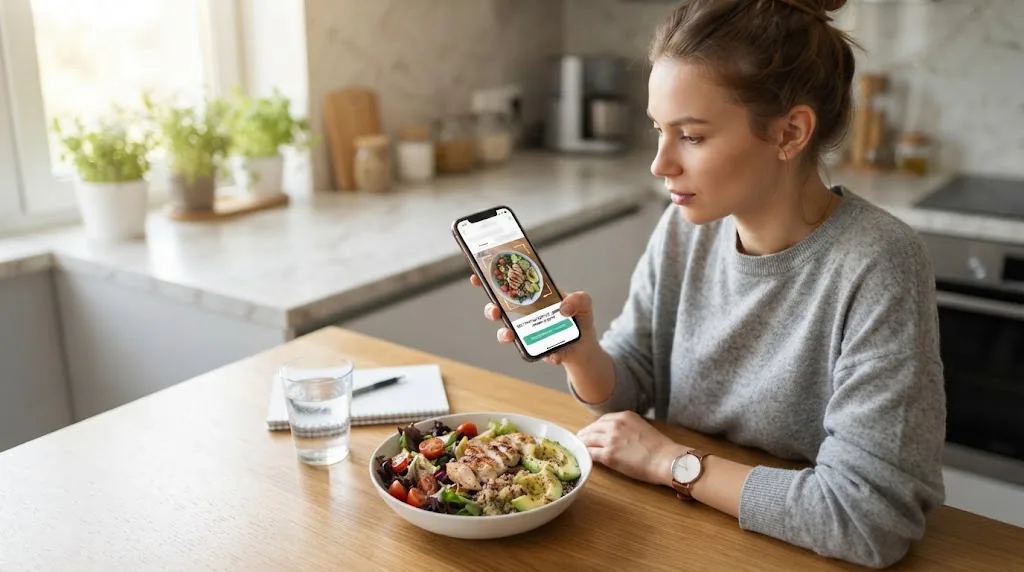
By the time your phone is back in your pocket, the photo has reached a server, where a model first works out what's on the plate, buckwheat, a meat patty, cucumber or sauce, then estimates the grams of each item from its area in the frame and the size of the plate and fork, and only then multiplies the grams by reference calories and works out protein, fat and carbs. Recognition and portion estimates are the expensive part, since they need large computer vision models and every request costs money. One request costs very little, but with thousands of users each photographing their food 4-5 times a day, the bill adds up.
In an ordinary diary, where you pick a food from a list and type in the grams, there's almost nothing to compute, and a database lookup costs next to nothing. That's why manual-entry diaries are often free, while photo recognition almost never is.
What "free" usually looks like
Behind a promise of "free calorie counting by photo" there's almost always one of five setups, and each has a spot worth checking in advance:
| Model | How it works | What to check |
|---|---|---|
| Free trial | Everything works for a few days, then you need a subscription | Whether a card is required to start and whether you'll be charged automatically |
| Analysis limit | A few photos a day for free, then you pay | Whether the limit covers all your meals |
| Website demo | Upload a photo and see the result without signing up | Whether the result is saved anywhere or it's just a showcase |
| Free with ads | Analyses are paid for by ads | How many ads and whether they get in the way of logging |
| Free "for data" | The service charges nothing but uses your photos and data | What the privacy policy says |
None of these is bad in itself. What's bad is hidden terms: for example, a free trial that silently turns into an annual subscription you forgot about.
If a "free" trial asks for your card, look straight away at when you'll be charged and how to cancel, and set a reminder on your phone for the day before the trial ends.
What you can get for free with us
On the home page there's a demo where you can upload a photo of your plate and immediately see the composition, grams, macros and FoodMate Score, with no sign-up and no bot, up to three photos a day. It's the easiest way to find out whether this way of counting suits you before installing anything.
In the bot, everything works fully after your first analysis, photos, text and voice descriptions, corrections and the meal picker, and you don't need a card for it. The trial countdown starts with that first analysis rather than at sign-up, so you can set up your profile at leisure and come back later. The length of the trial and the price of the subscription afterwards are always on the Pricing page.
Some things are free for good and without a time limit: the diary, manual entry, "My dishes", water, weight, the Progress screen and editing entries. Everything you've logged stays with you, and the subscription only covers what runs on the neural network, which is photo analysis, text and voice descriptions, corrections and the meal picker. Without a subscription the chat nutritionist still answers three free questions a week, and details on what the subscription includes are in the guide What Pro includes.
How to get the most without paying
If you're not ready to pay yet, the free option can still be genuinely useful. The first trial days are the most valuable, and they're best spent on "calibration": photograph everything, snacks and coffee included, and correct the analysis in words, so that you learn not so much the calories as your usual portions and where the extra ones come from. Meals you eat often, like the same breakfast every day, are worth saving to "My dishes" or favourites after they're analysed, because then you can add them manually, and manual entry is always free, as described in the guide Repeat meals: My dishes and favorites.
For new dishes there's the calorie catalog on our site, with dishes, products and chain menus listed with portions and cooking variations, free and with no sign-up: find your dish, check the calories for your portion and log it by hand. The website demo is best kept for tricky plates like a salad in a café or a dish at a friend's, and three photos a day is about right for those. The Progress screen with weekly averages and the weight tracker are free as well, and they're exactly what shows whether your deficit is working.
Is it worth paying at all
That's up to you, and the honest answer depends on whether your money or your time is worth more to you. Counting by hand from a food database costs nothing but takes effort, since you have to find the food, pick the right variant, weigh or estimate the grams and log it, and for most people that's exactly what makes them give up after a week or two. Photos and voice cut logging a meal down to a few seconds, and that's the main thing you're paying for. If you've been counting by hand for years and it suits you, there's no need to pay, but if you've dropped counting again and again because of the routine, photos may be what finally gets you to your goal.
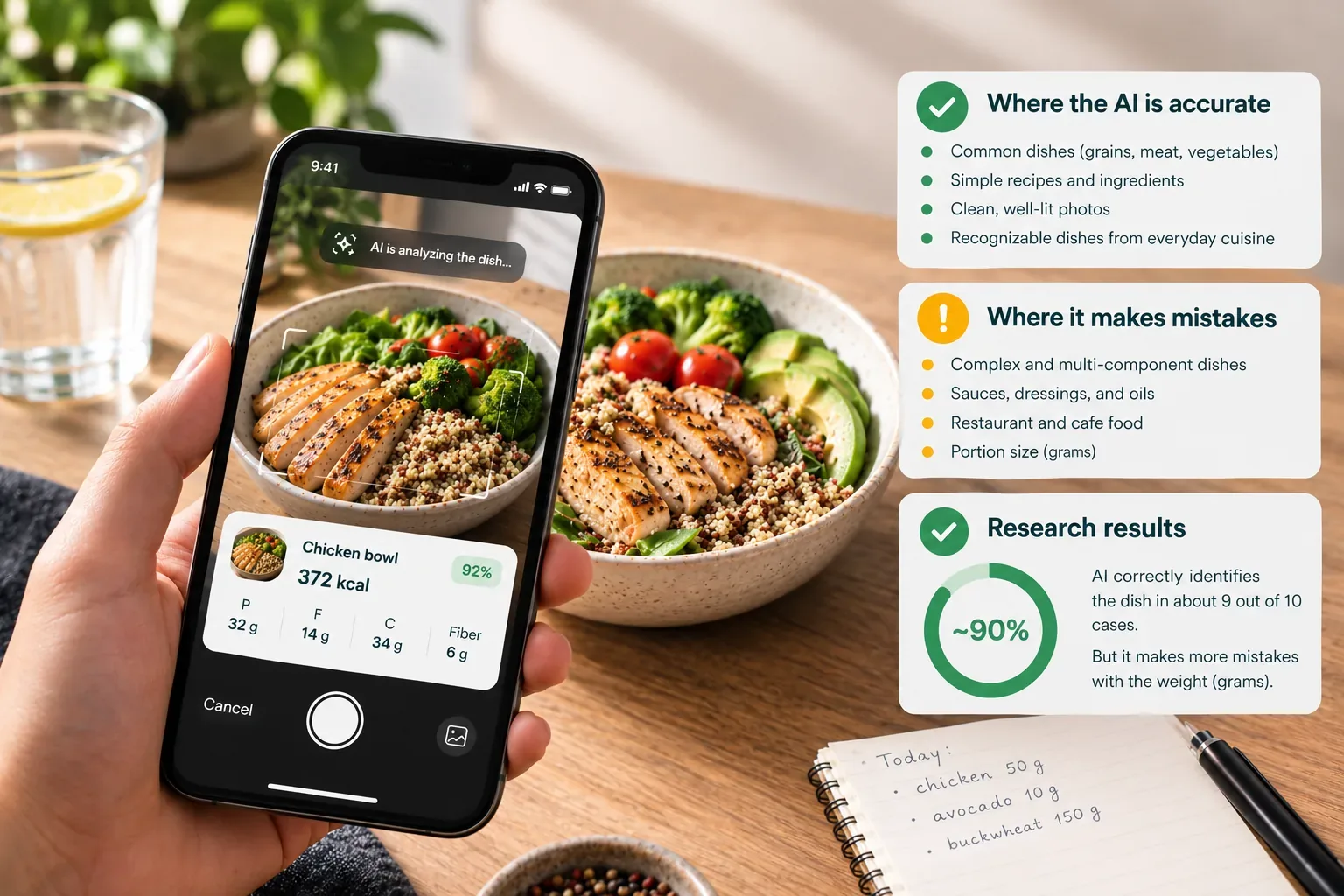
The neural network is good at recognising food and less good at estimating grams, especially with big portions, sauces and oil. We looked at the research on how big that error is and how to shrink it in Calories from a photo: how accurate AI is and where it goes wrong, and the short version is that the accuracy is enough for everyday counting, especially if you correct the analysis in words.
FAQ
Can I count calories from photos completely free and without limits?
Without limits - hardly anywhere, for the reasons above. If a service promises exactly that, look carefully at how it makes money: ads, data or paid features elsewhere.
Do I need to install an app?
Not for the demo - it works right on the website. MyFoodMate AI itself runs inside Telegram or MAX, so there's no separate app to install.
What happens to my entries after the trial days?
Nothing is lost. Your diary, history and weight stay; you can view them and add to them manually. Only the features that run on the neural network are closed.
Are demo photos saved?
The demo shows the analysis result but doesn't write anything to a diary: for a diary you need the bot.
Sources
- Subscription prices and terms - the Pricing page on the MyFoodMate AI website.
- What the free mode includes - the guide What Pro includes.

We check blog materials against current WHO recommendations.