Contents
The short answer
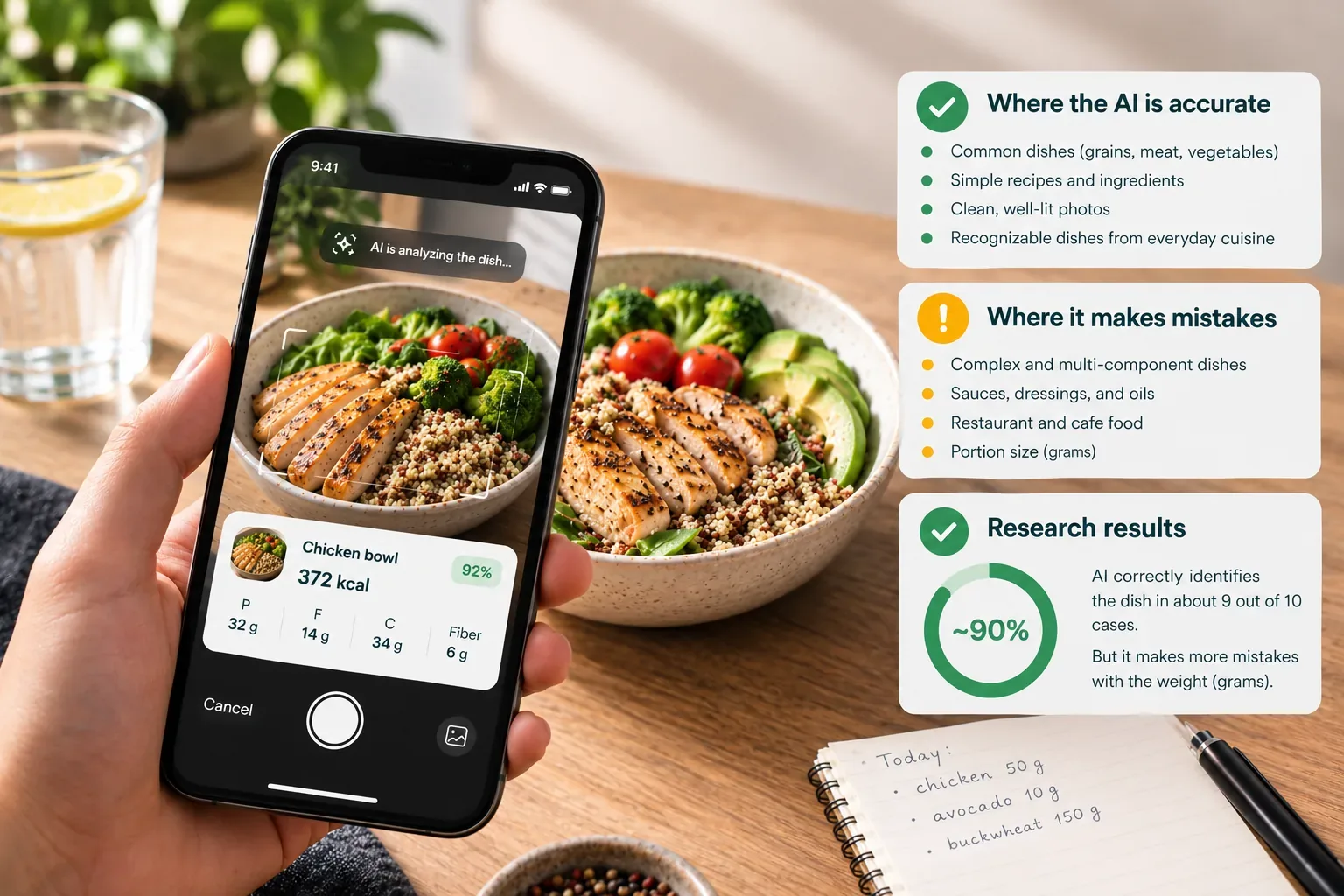
AI is good at telling what is on the plate and noticeably worse at telling how many grams are there. In a study of 114 photos of everyday meals, ChatGPT named the foods correctly 93% of the time but struggled with the weight of medium and large portions. In another study, the best models were off by about 36% on calories on average, while on standard hospital meals photographed straight from above, the best models often landed within ±10%.
Whether that is a lot depends on what you compare it with. In one well-known study, people who "could not lose weight" on a low-calorie diet under-reported what they ate by 47% on average, and "lighter" restaurant dishes turned out to contain 18% more calories than stated. A photo estimate does not replace a kitchen scale, but for everyday tracking it is comparable to the usual methods and takes a fraction of the effort. And you can raise its accuracy considerably with a good shot and a single correction in words.
How AI counts calories from a photo
A photo goes through three steps, and each one has its own error. First the model finds the separate components in the picture, the buckwheat, the cutlet, the cucumber and the sauce, and today's neural networks do this well. Then it estimates the weight from the area each component takes up in the frame and from the size of the plate, fork or hand next to it, and this is the weakest step, because volume is hard to judge in a flat picture. Finally the weight of each component is multiplied by its reference calorie value, which adds little error if the food was recognised correctly. So almost all of the error comes from the grams, not from "guessing" the dish.
What the research shows
Since 2025 researchers in Ireland, Sweden, Japan and elsewhere have put chatbots to the test against meals that were actually weighed:
| Study | What was tested | Main result |
|---|---|---|
| O'Hara et al., Nutrients, 2025 | ChatGPT-4, 114 meal photos from national dietary survey data | Foods identified with 93% precision. Small portions weighed well, medium and large ones poorly. For 13 of 16 nutrients the difference exceeded 10%, mostly underestimation |
| Fridolfsson et al., Current Developments in Nutrition, 2025 | ChatGPT-4o, Claude 3.5 Sonnet and Gemini 1.5 Pro on 52 standard photos, weighed reference | Mean calorie error 35.8% for ChatGPT and Claude; Gemini's errors were much larger, 64 to 110% across measures. All models underestimated large portions, more so the larger the portion |
| Isobe et al., Nutrients, 2026 | 15 hospital meals shot from above in even light; 10 dietitians and 10 AI models | For calories and carbohydrates the best models, like the dietitians, were often within ±10%. All models overestimated fat by more than 20% |
| Nakagawa and Yamamoto, Nutrients, 2026 | Three Claude models on Japanese and US meal photos and on packaged foods | Accuracy depends heavily on the model and on how the request is worded. On US photos, Claude Sonnet's mean error was about 117 kcal per meal |
The results vary a lot, and it's easy to see why. When the meals are simple and shot straight from above in good light, the error is small, but with mixed dishes, big portions and a random angle it grows several times over. All of these figures also come from general-purpose chatbots in a lab, and specialised apps can do better or worse, so it's worth being wary of an ad promising "98% accuracy" with no study behind it.
What to compare it with: how people and labels get it wrong
There is no perfect way to count calories outside a lab. Every method has its own error.
- Logging from memory. In a study published in the New England Journal of Medicine, people who could not lose weight on a "diet under 1200 kcal" were actually eating almost twice as much: they under-reported food by 47% on average and over-reported physical activity by 51%. The sample was small, but the mechanism is familiar: snacks and cooking oil simply never make it into the diary.
- Menu and package figures. In a Tufts University study, dishes from "lighter" restaurant menus contained 18% more calories than stated on average, and supermarket frozen meals 8% more. Some items contained twice the stated calories.
- Kitchen scales. The most accurate method at home, but it takes time at every meal and hardly works in cafes or at a friend's place.
The authors of the Swedish study concluded that the best models are comparable in accuracy to traditional self-reported dietary assessment while asking almost no effort of the user. They also warn that such estimates are not yet suitable where gram-level precision matters.
Where photo estimates go wrong most often
| Situation | Why it goes wrong | What to do |
|---|---|---|
| Large portion | Models systematically underestimate large portions | Give the weight in words: "it was 350 grams" |
| Fried food, dressings, sauce inside | The oil has soaked in and is not visible | Add oil or sauce separately: "fried in a tablespoon of oil" |
| Mixed dishes: pilaf, casseroles, mayo salads | The inside is not visible, so the model assumes an average recipe | Describe the key part: "chicken pilaf, no extra oil on top" |
| Deep bowl, sharp angle | Only the top of the portion is visible | Shoot from above and add the amount in words |
| Drinks | Sugar, cream and syrup are invisible | Say what was added: "coffee with two spoons of sugar" |
Note that two of the five mistakes are about fat. This matches the Japanese study, where fat turned out to be an "invisible nutrient" for every model.
How to photograph your plate for a smaller error
- From above, at about 90°. This shows the area of each component, which is what the weight is estimated from. A side shot hides half the portion.
- In normal light, without flash. Flash washes out texture, so rice starts to look like bulgur and sour cream like mayonnaise.
- The whole portion in the frame. Include bread, sauce in a separate dish and the drink too. Anything cropped out will not be counted.
- With something for scale. A fork, spoon or standard plate next to the food helps judge the portion size. In one of the studies the models relied on plates and cutlery exactly this way.
- Before you eat, not after. A half-eaten portion can be corrected in words; an empty plate tells nothing.
A detailed checklist with examples is in the guide "How to take a good photo", and if a dish was not recognised, see "What to do if a dish is not recognised".
Correcting in words: the fastest way to cut the error
A photo analysis is a draft, not a final answer. In MyFoodMate AI you can correct it by voice or text, and the app recalculates the composition and macros:
- "double portion" multiplies the grams of the whole dish;
- "no oil" removes a component;
- "it was 200 grams" sets the weight of a specific component;
- "add a slice of bread" adds a component to the meal.
One such correction narrows the error range roughly by half. If you often eat the same thing, correct the grams once: after that you can add the dish from "My dishes" or from favorites, and the portion you set is filled in. More in the guides "Voice and text corrections" and "Repeat meals".
When a photo is enough and when you need scales
A photo is fine if you:
- want to understand your habits and see where extra calories come from;
- are losing weight with a moderate deficit and look at weekly results rather than daily ones;
- often eat out, where weighing food is impossible anyway.
Random errors in both directions partly cancel out over a week, so weekly averages are what to watch first; see the guide Weekly averages. Systematic errors, such as oil that is never counted, will not disappear on their own: correct them once in words and save the dish to "My dishes" or favourites.
Kitchen scales are better if:
- you are preparing for a competition and every 50 kcal counts;
- a doctor prescribed your diet and you need exact numbers, for example carbohydrate units for diabetes;
- your weight has not moved for several weeks and you need to check that your tracking matches reality.
How to try it
There's a demo on the home page: upload a photo of your plate and you'll see the composition, macros and FoodMate Score without signing up, up to three photos a day. The full version, with a food diary, voice corrections and "My dishes", runs as a bot in Telegram and MAX.
Sources
- O'Hara C, Kent G, Flynn AC, Gibney ER, Timon CM. An Evaluation of ChatGPT for Nutrient Content Estimation from Meal Photographs. Nutrients, 2025.
- Fridolfsson J, Sjöberg E, Thiwång M, Pettersson S. Performance Evaluation of 3 Large Language Models for Nutritional Content Estimation from Food Images. Current Developments in Nutrition, 2025.
- Isobe T et al. Accuracy of AI-Based Nutrient Estimation from Standardized Hospital Meal Images: A Comparison with Registered Dietitians. Nutrients, 2026.
- Nakagawa S, Yamamoto A. Prompt Engineering and Model Selection for LLM-Based Nutritional Estimation from Food Images. Nutrients, 2026.
- Lichtman SW et al. Discrepancy between self-reported and actual caloric intake and exercise in obese subjects. New England Journal of Medicine, 1992.
- Urban LE et al. The accuracy of stated energy contents of reduced-energy, commercially prepared foods. Journal of the American Dietetic Association, 2010.
We check blog materials against current WHO recommendations.