Contents
1 kcal per kilogram per kilometre
Running has a handy rule: for every kilometre you burn roughly as many kilocalories as you weigh in kilograms. At 70 kg a kilometre costs about 70 kcal, 5 km 350, 10 km 700.
Speed matters less than it seems. A fast runner covers a kilometre in 5 minutes, a slow one in 7, but they burn almost the same on it. The fast runner simply covers more ground in the same time.
Table: calories burned running by body weight
Calculated with the "1 kcal per kg per km" rule on flat ground.
| Distance or time | 60 kg | 70 kg | 80 kg | 90 kg |
|---|---|---|---|---|
| 1 km | 60 | 70 | 80 | 90 |
| 3 km | 180 | 210 | 240 | 270 |
| 5 km | 300 | 350 | 400 | 450 |
| 10 km | 600 | 700 | 800 | 900 |
| 10 minutes easy, 8 km/h | 80 | 95 | 105 | 120 |
| 30 minutes, 8 km/h | 240 | 280 | 320 | 360 |
| 30 minutes, 10 km/h | 300 | 350 | 400 | 450 |
| 1 hour, 10 km/h | 600 | 700 | 800 | 900 |
| 1 hour, 12 km/h | 720 | 840 | 960 | 1,080 |
The table shows total expenditure during the run. To see how much running added on top of sitting, subtract about 1 kcal per kg for each hour: for 70 kg and a half-hour run that is minus 35 kcal.
Where the rule comes from
It follows from the American College of Sports Medicine (ACSM) equation: running on the flat uses about 0.2 ml of oxygen per kilogram of body weight per metre. That is 200 ml per kg per kilometre, and a litre of oxygen corresponds to about 5 kcal. Result: 1 kcal per kg per km.
The Compendium of Physical Activities gives similar numbers: running at about 10 km/h is rated at 9.8 METs, almost ten times resting metabolism. For 70 kg that is about 690 kcal per hour.
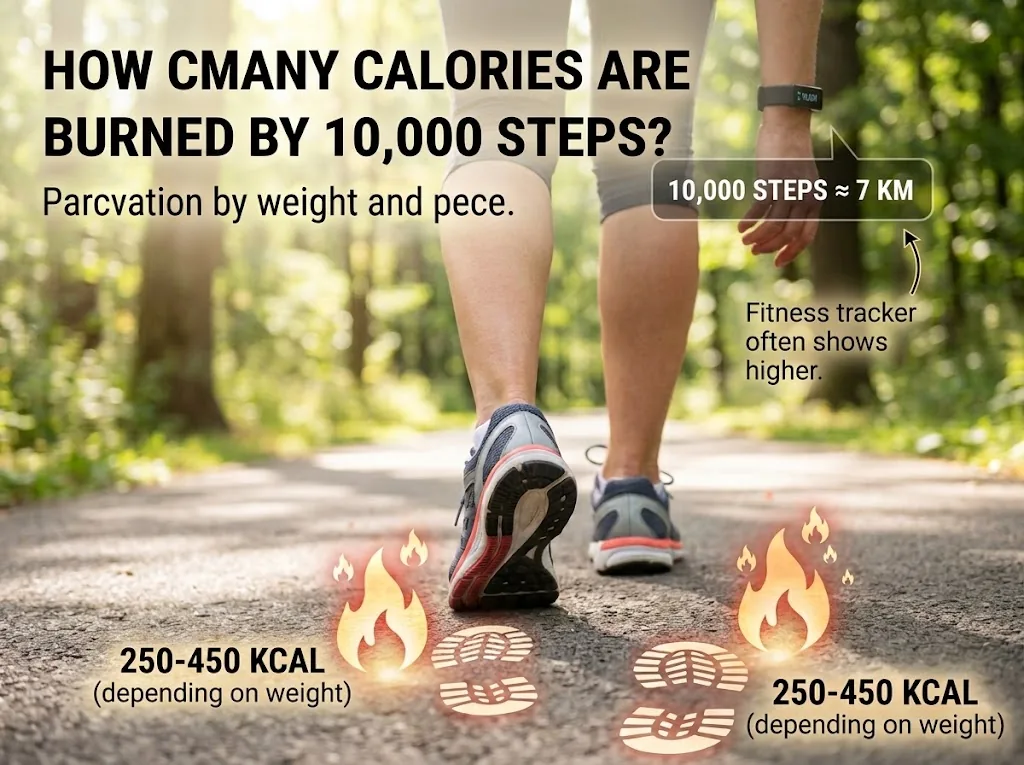
More on walking in How many calories do 10,000 steps burn.
Treadmill, running in place, uphill
| Option | What changes |
|---|---|
| Treadmill, no incline | a few percent less than outdoors: there is no air resistance. A 1% incline evens it out |
| Uphill, 5% grade | cost per kilometre rises by about 25-35% |
| Running in place | 8-9 METs, about 95-105 kcal per 10 minutes at 70 kg |
| Intervals | sprints burn more, but over a whole session the difference from steady running is usually small |
| Snow and sand | 20-60% more than asphalt |
Why your watch shows a different number
Sports watches and fitness bands work out calories from your heart rate, speed and profile, and studies keep finding errors of 20-40% in their energy estimates, with different models disagreeing by half as much again on the very same run. Distance and time they measure far more accurately, so the most reliable approach is to count from kilometres and body weight, and the "1 kcal per kg per km" rule does no worse than most watches.
"Afterburn" after a run
Metabolism does stay raised for a while after a run, but not by much. When the Norwegian physiologists Jørgen Børsheim and Roald Bahr reviewed all the studies on it in 2003, they usually found 6-15% of the cost of the workout itself, which after a 5 km run means 20-50 kcal and a little more after hard intervals, so "burning all day" isn't something to count on.
Running and appetite: where the deficit gets lost
A 350 kcal run is easy to win straight back, because a chocolate bar and a sweet cappuccino on the way home from the park come to the same 350-400 kcal. That's no reason to run less, as running is great for the heart and the mood, but it only helps you lose weight if it doesn't become a licence to eat more. Don't add your watch's calories to your target; if you run regularly, raise your activity level once in the daily calorie calculator. Eat normally before and after, since a run on an empty stomach more often ends in an evening binge, as explained in Eating around workouts, and judge by the week, because running burns a different amount every time.
How to count if you run
MyFoodMate AI takes care of the food side, so you photograph a plate or dictate a snack and it goes into the diary, while your calorie target already reflects the activity level from your profile and is worth recalculating once running becomes a habit rather than adding each run by hand. The parkrun movement, which began with thirteen runners in a London park in 2004, now gets hundreds of thousands of people out every Saturday morning, and the café next to the finish line is exactly where many of those 5 km quietly get eaten back.

We check blog materials against current WHO recommendations.