Contents
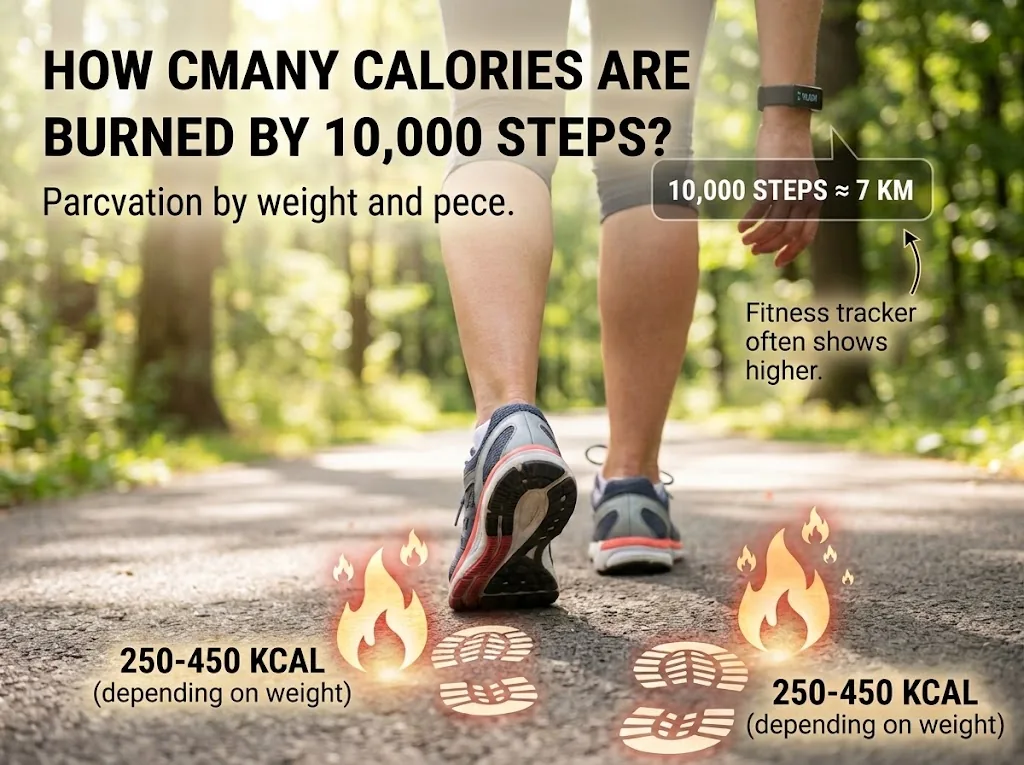
250-450 kcal for 10,000 steps
10,000 steps is roughly 7 km for someone about 170 cm tall. A person weighing 70 kg spends about 350 kcal on them, and about 250 kcal of that is on top of what they would burn sitting on the sofa. The heavier you are, the more you burn: at 90 kg it is about 450 kcal in total and 315 kcal "net".
Below is where these numbers come from and how to work out your own.
Table: calories for 10,000 steps by body weight
Calculated for a normal pace of 5 km/h, flat ground and a 70 cm stride, which makes 7 km.
| Body weight | kcal total | kcal above rest | Time |
|---|---|---|---|
| 50 kg | 250 | 175 | about 1 h 25 min |
| 60 kg | 300 | 210 | about 1 h 25 min |
| 70 kg | 350 | 245 | about 1 h 25 min |
| 80 kg | 400 | 280 | about 1 h 25 min |
| 90 kg | 450 | 315 | about 1 h 25 min |
| 110 kg | 540 | 385 | about 1 h 25 min |
"Total" is everything the body spent during an hour and a half of walking, including breathing, heart and brain. "Above rest" is what the walking itself added. For weight loss the second column is the one that matters: your basal metabolism is already included in your daily target.
A formula for your own numbers
For walking on flat ground there is a simple rule derived from the American College of Sports Medicine (ACSM) walking equation:
kcal above rest ≈ 0.5 × body weight in kg × km
Example: 64 kg, 9 km walked. 0.5 × 64 × 9 = 288 kcal. For the "total" figure, multiply by 0.7 instead of 0.5.
To turn steps into kilometres, multiply the number of steps by your stride length. A typical stride is 41-42% of your height: about 66 cm at 160 cm tall and about 77 cm at 185 cm. A tall person covers more ground in 10,000 steps and so burns more.
What changes the burn
- Incline. Walking up a 5% grade almost doubles the cost per kilometre. Stairs are one of the most "expensive" ways to move.
- Load. Shopping bags and a backpack count as body weight in the formula: a 70 kg person carrying 8 kg of groceries counts as 78 kg.
- Surface. Walking on loose snow or sand costs one and a half to two times as much as walking on asphalt.
- Speed above 6.5 km/h. At a very brisk pace walking becomes inefficient and the cost per kilometre rises.
Why your tracker shows more
Watches and fitness bands usually show "active" or "total" calories, and the definitions differ between apps. Studies comparing trackers with gas-exchange measurements show that they count steps fairly accurately, but calories with an error of roughly 20-40%, more for some models, and more often too high than too low.
The practical takeaway: if you add everything the tracker shows to your daily target, your deficit melts away. It is safer to treat steps as part of your normal lifestyle, already built into the activity factor of your daily target, rather than as a bonus on top.
10,000 steps and weight loss
On their own, 245 net kcal is not much: about one sausage sandwich plus a mug of tea with two spoons of sugar. But walking is good for more than the number:
- it is easy to do every day, and 245 kcal × 30 days = 7,350 kcal a month;
- it barely drives up appetite, unlike hard workouts;
- it raises the part of energy expenditure that is hard to get any other way, everyday activity.
The number 10,000 was invented by Japanese pedometer marketers in the 1960s, not by doctors. A large meta-analysis in The Lancet Public Health (2025) found that around 7,000 steps a day is already linked to a much lower risk of death and heart disease compared with 2,000 steps, and that the benefit grows more slowly beyond 7,000-10,000. So if 10,000 does not happen, 7,000 is a good result too.
How to account for steps when counting calories
The simplest way is to set the right activity level once in the daily calorie calculator and from then on count only food. If you used to manage about 3,000 steps a day and since spring you've been walking to work and back and hitting 10,000, recalculate your target at a higher activity level rather than adding the walk by hand every evening. When your steps are irregular, say 15,000 on a Saturday in the park and barely 2,000 on weekdays, don't eat them back straight away, wait a week and look at the averages, which will show whether the deficit is working, as explained in our article on a calorie deficit without binges.
Sources
- American College of Sports Medicine. ACSM's Guidelines for Exercise Testing and Prescription, 11th ed. Walking energy expenditure equation.
- Ainsworth BE et al. 2011 Compendium of Physical Activities. Medicine & Science in Sports & Exercise, 2011.
- Ding D et al. Daily steps and health outcomes in adults: a systematic review and dose-response meta-analysis. The Lancet Public Health, 2025.

We check blog materials against current WHO recommendations.