Contents
About 215 kcal per 0.5 L bottle
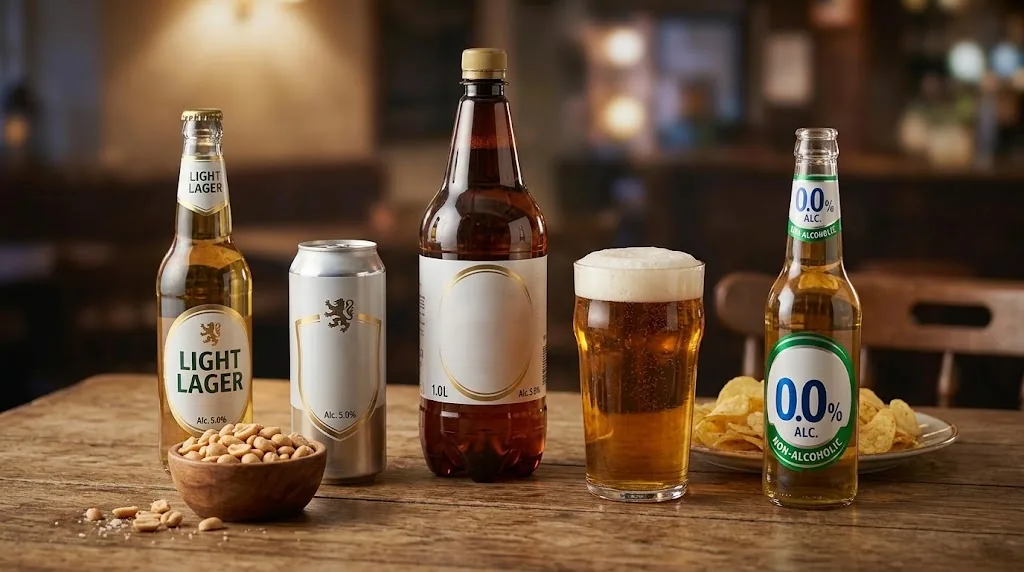
With ordinary lager at 4.5-5% you're looking at 42-45 kcal per 100 ml, which makes a 0.33 L can 140-150 kcal, a 0.45 L can 190-200 and a half-litre bottle 210-225. A litre comes to about 430, and the 1.5 L plastic bottles you see stacked by the till in Russian corner shops to around 650, while strong beer at 7-9% reaches 300-375 kcal per half litre and alcohol-free stays at 100-170.
Table: calories in beer by style
Different styles vary more than you'd expect, so here they are per 100 ml and per usual serving:
| Beer | kcal per 100 ml | 0.33 L | 0.5 L | 1 L |
|---|---|---|---|---|
| Alcohol-free | 20-35 | 65-115 | 100-170 | 200-350 |
| Light lager, up to 4% | 30-38 | 100-125 | 150-190 | 300-380 |
| Regular lager, 4.5-5% | 42-45 | 140-150 | 210-225 | 420-450 |
| Wheat beer, unfiltered | 45-50 | 150-165 | 225-250 | 450-500 |
| Dark beer, 5-6% | 45-55 | 150-180 | 225-275 | 450-550 |
| Ale, IPA, 6-7% | 55-70 | 180-230 | 275-350 | 550-700 |
| Strong beer, 8-9% | 60-75 | 200-250 | 300-375 | 600-750 |
Unfiltered beer is barely heavier than filtered, because the yeast sediment adds only a few calories, and colour tells you little: a stout gets its darkness from roasted malt, and a pint of Guinness, at about 210 kcal, is actually lighter than many pale lagers of the same size.
Where beer calories come from: a formula based on ABV
Two thirds of the calories in lager come from the alcohol, because a gram of alcohol has 7 kcal, almost twice as much as a gram of sugar, and the rest is unfermented malt carbohydrate at about 3-4 g per 100 ml. You can work out the alcohol calories straight from the label:
kcal from alcohol ≈ volume in ml × ABV in % × 0.055
For a 500 ml bottle at 5% that's 500 × 5 × 0.055 = 138 kcal, and adding 70-80 kcal of carbohydrate gives the familiar 210-220. It also shows why strong beer is so heavy: in an 8% beer the alcohol alone is worth 220 kcal per half litre.
Alcohol-free beer isn't necessarily light, though. It has less alcohol but more sugar, because fermentation was stopped early or the alcohol was removed while the malt carbohydrates stayed, and with some brands half a litre is 150-170 kcal, only a quarter less than regular beer, so check the label.
The snacks count more often than the beer
A beer evening is usually heavy not because of the beer but because of what sits next to the glass:
| Snack | Serving | kcal |
|---|---|---|
| Potato chips | 140 g bag | 720-770 |
| Salted peanuts | handful, 30 g | 170 |
| Salted peanuts | 50 g packet | 285-300 |
| Rye croutons (sukhariki) | 40 g packet | 160-180 |
| Dried squid | 50 g | 130-145 |
| Dried salted fish | 100 g | 200-300 |
| Breaded cheese sticks | 5 pieces, 100 g | 300-330 |
Two bottles of beer and a bag of chips come to about 1,200 kcal, more than half of many people's daily target. The beer isn't the main culprit, but alcohol makes snacking almost invisible, and after a couple of glasses nobody keeps track of how many peanuts went.
How beer affects weight loss
While the liver deals with alcohol, the body nearly stops burning fat. In 1999 researchers at the University of California, Berkeley gave volunteers a drink and found that their fat oxidation dropped by roughly three quarters afterwards. Alcohol itself is hardly turned into fat, but fat from food eaten with it is stored more readily. On top of that, people eat more after drinking and reach for fatty, salty food, and the next morning the scale often shows 0.5-1 kg more, which is salt and retained water that goes in a day or two.
If you're keeping a calorie deficit, a bottle of beer can fit into your target like any other food. But the habit of "two half-litres every evening" is 430 kcal a day and about 13,000 kcal a month, close to two kilos of fat.
How to log beer
In MyFoodMate AI you can photograph the beer together with the snacks or write it in words, such as "lager 0.5 and a handful of peanuts". Say whether it's strong or alcohol-free, since the calories differ almost twofold, and voice input comes in handy in a bar where typing is awkward.

We check blog materials against current WHO recommendations.