Contents
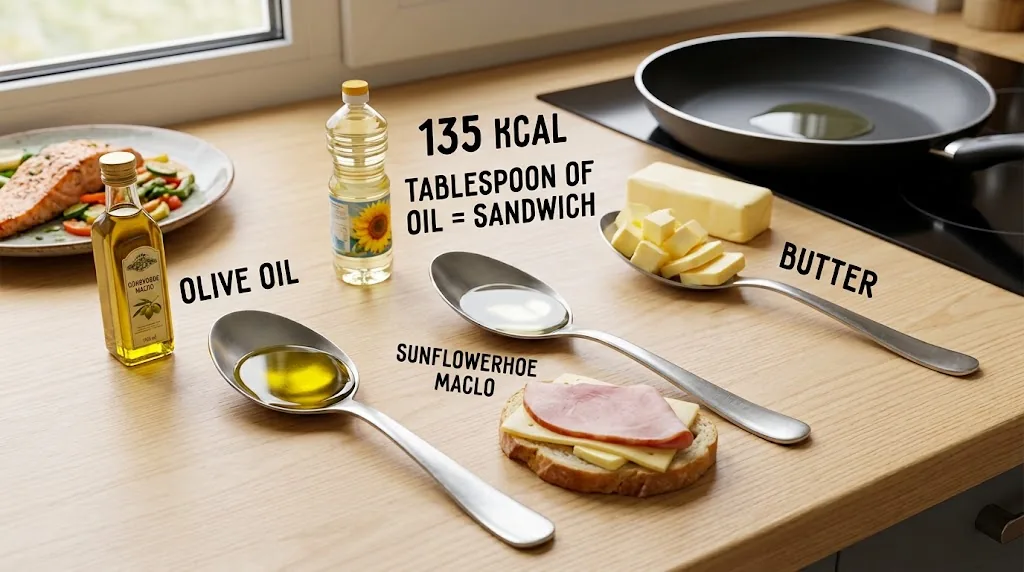
135 kcal per tablespoon
- A tablespoon of vegetable oil (15 g): 135 kcal.
- A teaspoon (5 g): 45 kcal.
- A tablespoon of 82.5% butter (17 g): 127 kcal; a teaspoon (5 g): 37 kcal.
Sunflower, olive, flaxseed, corn and coconut oil are the same in calories: all vegetable oils are almost 100% fat, and a gram of fat gives 9 kcal. They differ in flavour, smoke point and fatty acid profile, not in calories.
Table: calories in a spoon of oil
| Oil | kcal per 100 g | Teaspoon | Tablespoon |
|---|---|---|---|
| Sunflower | 899 | 5 g, 45 kcal | 15 g, 135 kcal |
| Olive | 898 | 5 g, 45 kcal | 15 g, 135 kcal |
| Flaxseed, corn, rapeseed | 898-899 | 5 g, 45 kcal | 15 g, 135 kcal |
| Coconut | 899 | 5 g, 45 kcal | 15 g, 135 kcal |
| Ghee | 890-900 | 5 g, 45 kcal | 15 g, 134 kcal |
| Butter 82.5% | 748 | 5 g, 37 kcal | 17 g, 127 kcal |
| Butter 72.5% | 660 | 5 g, 33 kcal | 17 g, 112 kcal |
| Spread, soft margarine | 500-650 | 5 g, 25-33 kcal | 17 g, 85-110 kcal |
Catalog pages: Olive, Butter 82.5%.
Two tablespoons of vegetable oil come to 270 kcal and three to 405, more than a whole bowl of borscht.
How much oil is really in a spoon
A tablespoon holds 15 ml, and since vegetable oil is lighter than water, a level spoon is 14 g while one filled to the brim from the bottle is 17-20 g, so our figures are for 15 g, a normal spoon that isn't overfilled. The bigger issue is that hardly anyone measures oil with a spoon at all; it gets poured straight from the bottle by eye, and the error can be several-fold:
| How it was poured | How much oil | kcal |
|---|---|---|
| Sprayed, 1-2 pumps | 1-2 g | 9-18 |
| A thin stream "to grease the pan" | 5-8 g | 45-70 |
| "A little", one circle round the pan | 15-20 g | 135-180 |
| "As usual" for frying potatoes | 30-50 g | 270-450 |
Pour your usual amount into a spoon or put the pan on the scales once, and you'll know your real figure. If you count your food honestly and your weight still won't move, oil is the first thing to check, because two "invisible" spoonfuls a day are 270 kcal, nearly the whole deficit that weight loss depends on, and the other reasons are covered in our article on a calorie deficit.
How much oil stays in food when frying
Not all the oil in the pan reaches the plate. Practical guidelines:
| Dish | How much oil to count |
|---|---|
| Salad dressing | 100% |
| Braised vegetables, soup base | 100% |
| Fried eggplant, mushrooms, courgettes | 80-100%: vegetables soak up almost all of it |
| Fried potatoes | 60-80% |
| Fried eggs, omelette | 70-90% |
| Cutlets, chops, chicken | 30-50%: some stays in the pan |
| Pancakes (bliny) | 30-50% of the oil in the pan, plus oil in the batter |
| Deep-frying | food absorbs 5-40% of its weight, depending on the food and coating |
If in doubt, count all of it, and you'll err on the safe side.
How to save on oil without losing flavour
- A non-stick pan. A teaspoon is enough instead of a tablespoon.
- A brush or a sprayer. Oil goes on in a thin layer, 2-5 g instead of 15-20.
- Heat the pan first, then add oil. In a hot pan oil spreads thinner, and you need less.
- Dress salad in the bowl, not on the plate. A tablespoon of oil is enough for a big bowl for 2-3 people, not for one portion.
- Braise instead of frying. Onion and carrot for soup can be softened in broth: minus 135-400 kcal per pot.
Why you should not cut oil out completely
Fats are needed: to absorb vitamins A, D, E and K, for hormones and simply for flavour. Vegetable oils are the main source of polyunsaturated fatty acids, and olive oil of monounsaturated ones. A completely fat-free diet is hard to stick to and does not keep you full.
A sensible goal is not zero but a conscious 1-2 tablespoons of oil a day, logged in your diary. Why fat is so "expensive" in calories is explained in How many calories in 1 gram of protein, fat and carbohydrate.
How to log oil
Oil cannot be seen in a photo, so it is the main "invisible" ingredient. In MyFoodMate AI it is easy to add in words: "fried in a tablespoon of oil" or "salad with two spoons of olive oil". The app recalculates the dish.
We check blog materials against current WHO recommendations.