Calories per serving
| Serving | Kcal | P | F | C |
|---|---|---|---|---|
| Small banana, peeled, 90 g | 86 | 1.4 | 0.5 | 18.9 |
| Medium banana, peeled, 120 g | 115 | 1.8 | 0.6 | 25.2 |
| Large banana, peeled, 150 g | 144 | 2.3 | 0.8 | 31.5 |
| 2 medium bananas, 240 g | 230 | 3.6 | 1.2 | 50.4 |
| 100 g | 96 | 1.5 | 0.5 | 21.0 |
Your plate isn't the average one
The table shows average reference values. Take a photo of your plate: we will count the composition, macros and FoodMate Score of exactly your serving. Free, no sign-up, the photo is not stored.
Drop a food photo here
Or choose a file from your computer. A regular top-down photo of the plate in daylight works best.
FoodMate Score of the food
This is a score for the food on its own, by its composition per 100 g, using the same formula the app applies to a meal. On a plate with other foods the result will differ: buckwheat with vegetables scores higher than buckwheat alone.
How it changes with different cooking methods
| Version | Serving |
|---|---|
| Ripe, yellow | 115 kcal |
| Greenish, underripe | 115 kcal |
| Frozen | 115 kcal |
| Banana chips, 30 g handful | 156 kcal |
Micronutrients
Values for a standard serving, as a percentage of the daily value for an adult.
| Nutrient | Per serving | % DV |
|---|---|---|
| Potassium | 430 mg | 12% |
| Vitamin B6 | 0.4 mg | 20% |
| Manganese | 0.3 mg | 15% |
| Vitamin C | 10.4 mg | 10% |
| Magnesium | 32.4 mg | 8% |
How many calories are in one banana
A medium store banana weighs 170-190 g with the peel and has about 120 g of flesh: 115 kcal, 1.8 g of protein and 25 g of carbs. A small peeled banana of about 90 g gives 86 kcal, a large one of 150 g gives 144 kcal. Two medium bananas are 230 kcal. For more precision, weigh the whole banana and take two thirds of the weight: that is roughly the flesh.
Banana with and without peel
Calories on labels and in tables always refer to the flesh. The peel is 30-40% of a banana, and nobody counts it because nobody eats it. Hence the confusion: a 180 g banana in its peel is not 173 kcal but about 115. If your scale shows the weight with the peel, multiply it by 0.64 and then by 0.96.
Ripe and green bananas
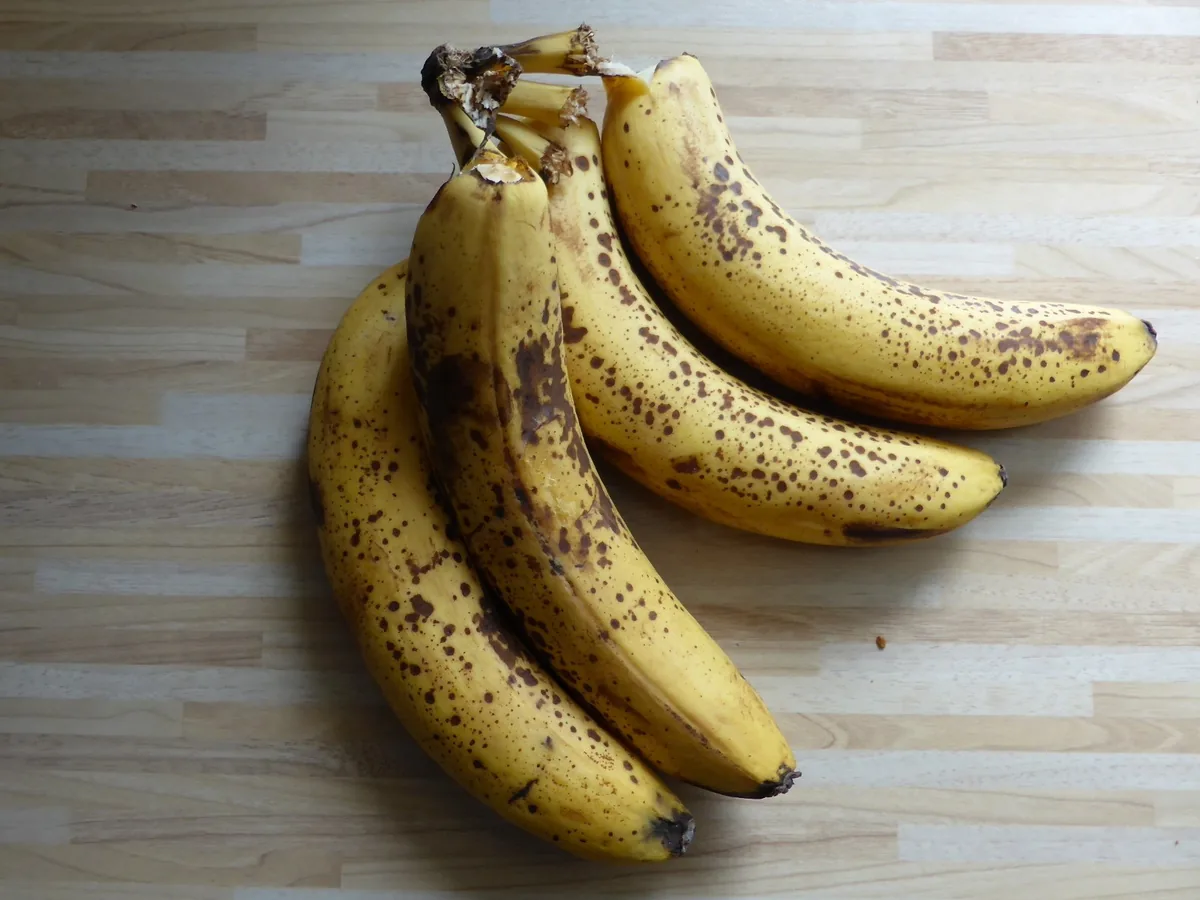
In calories, ripe and underripe bananas are almost the same. The difference is in the carbs: a greenish banana has more resistant starch that is digested slowly, while in a ripe one with brown spots the starch has already turned into sugar. So a ripe banana is sweeter and raises blood sugar faster, while a green one keeps you full longer. Banana chips are a different food: they are fried in oil, often with sugar, and a 30 g handful already has 156 kcal.
Bananas for weight loss
Bananas are often cut from a diet as a high-calorie fruit, but 115 kcal for a whole banana is less than most snack bars, and it has fiber, potassium and vitamin B6. It is a handy snack before a workout or with yogurt or cottage cheese, where carbs are missing. A problem appears only if bananas become the base of your diet: they have almost no protein, and the fullness does not last long.
How to count your serving
Weigh the peeled banana and multiply the weight by 0.96. Or just log a medium banana as 115 kcal: the error will be within 20-30 kcal. If the banana is in a smoothie or on oatmeal with nuts, take a photo in MyFoodMate AI and the app counts everything together.