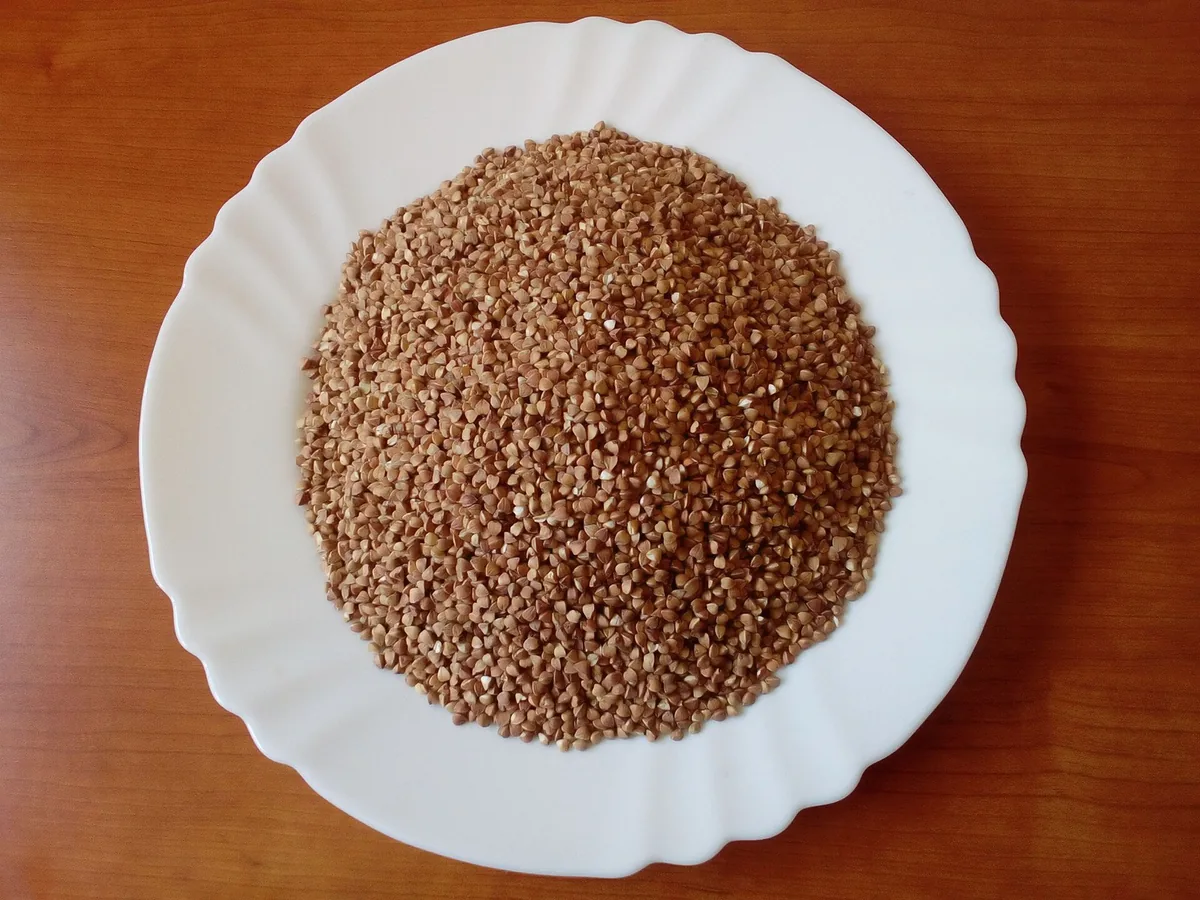
Calories per serving
| Serving | Kcal | P | F | C |
|---|---|---|---|---|
| 100 g | 110 | 4.2 | 1.1 | 21.3 |
| Tablespoon of cooked buckwheat, 25 g | 28 | 1.1 | 0.3 | 5.3 |
| Side serving, 150 g | 165 | 6.3 | 1.7 | 32.0 |
| Large plate, 250 g | 275 | 10.5 | 2.8 | 53.3 |
Your plate isn't the average one
The table shows average reference values. Take a photo of your plate: we will count the composition, macros and FoodMate Score of exactly your serving. Free, no sign-up, the photo is not stored.
Drop a food photo here
Or choose a file from your computer. A regular top-down photo of the plate in daylight works best.
FoodMate Score of the food
This is a score for the food on its own, by its composition per 100 g, using the same formula the app applies to a meal. On a plate with other foods the result will differ: buckwheat with vegetables scores higher than buckwheat alone.
How it changes with different cooking methods
| Version | Serving |
|---|---|
| Boiled in water | 165 kcal |
| Boiled with salt | 165 kcal |
| With butter (150 g and 10 g of butter) | 240 kcal |
| Porridge with 2.5% milk | 142 kcal |
| Dry groats, 55 g (about 150 g cooked) | 172 kcal |
Micronutrients
Values for a standard serving, as a percentage of the daily value for an adult.
| Nutrient | Per serving | % DV |
|---|---|---|
| Manganese | 0.6 mg | 30% |
| Magnesium | 76.5 mg | 18% |
| Copper | 0.2 mg | 20% |
| Phosphorus | 105 mg | 15% |
| Iron | 1.2 mg | 9% |
Calories in buckwheat: dry and cooked
A pack of buckwheat groats says 313 kcal per 100 g: 12.6 g of protein, 3.3 g of fat and 57 g of carbs. But that is dry groats. When cooked, buckwheat absorbs water and gets 2.7-3 times heavier, so 100 g of porridge boiled in water has about 110 kcal, 4.2 g of protein and 21 g of carbs. The pot did not lose calories, they are just spread over more weight. The rule: if you weigh the dry groats, use the pack number, if you weigh the cooked porridge, use 110.
Buckwheat with water, salt and butter
Salt adds no calories, so salted and unsalted buckwheat are the same 110 kcal per 100 g. Only fat changes the number noticeably: a 10 g piece of butter is another 75 kcal, and a 150 g side goes from 165 kcal to 240. Buckwheat porridge with milk and no sugar is about 95 kcal per 100 g: some of the groats on the plate are replaced by milk, which is lighter than porridge. A spoon of sugar adds another 30-40 kcal.
How much dry groats to use per serving
55-60 g of dry buckwheat gives a 150-170 g side, which is about 170-190 kcal. A large plate takes 80-90 g of groats. A standard 200 ml glass holds about 165 g of dry buckwheat: 516 kcal and three to four servings of porridge. A tablespoon of dry groats weighs about 25 g and gives 78 kcal.
Buckwheat for weight loss
Buckwheat is filling for its calories: it has fiber and more protein than rice or pasta. A 150 g serving is 165 kcal and keeps you full for a long time. A buckwheat-only diet shows fast results on the scale, but mostly through an overall calorie deficit and water, and the weight usually comes back. It works better as a side next to protein and vegetables: meat or fish plus a salad make the plate complete.
How to count your serving
Weigh the groats before cooking and multiply by 3.13 to get the calories of the whole pot. Or weigh your cooked serving and multiply by 1.1. If the buckwheat is already on a plate with meat and gravy, take a photo in MyFoodMate AI: the app estimates the weight of each food and logs the calories.