Contents
What is the FoodMate Score?
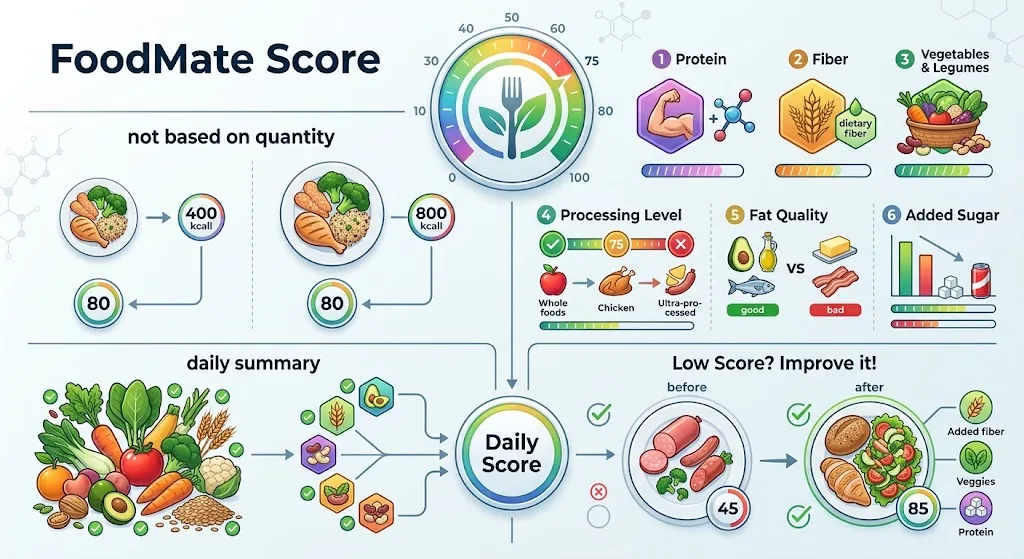
The FoodMate Score is a 0-100 rating of the quality of what you eat. Every dish you photograph in MyFoodMate AI gets one, and so does every day in your diary.
The key thing to know: the Score does not depend on how much you eat. A balanced 800 kcal lunch and the same lunch at 400 kcal get the same rating. Your calorie target is about quantity; the Score is about composition. Mixing them into one number would make the metric reward undereating, and the service is built on the opposite promise.
What the Score is made of
The model follows the principle of the Healthy Eating Index: several independent components, each with its own scale and weight, and the total is their sum. A meal has six components:
| Component | Weight | Zero points | Maximum |
|---|---|---|---|
| Protein | 20 | 1.5 g per 100 kcal | 7 g per 100 kcal |
| Fiber | 20 | 0.3 g per 100 kcal | 2 g per 100 kcal |
| Vegetables and legumes | 20 | 5% of weight | 45% of weight |
| Processing | 20 | ultra-processed foods | whole foods |
| Fat quality | 10 | saturated fat at 20% of calories | 7% of calories |
| Free sugar | 10 | 20% of calories | 5% of calories |
Between zero and maximum the scale is linear, with no hidden adjustments: you should be able to understand why you got 68 and not 74. The full table is available in the app on the "How the Score is calculated" screen.
Where the thresholds come from. 7 g of protein per 100 kcal is exactly 130 g of protein a day at 2,000 kcal. The fiber cap is slightly above the Institute of Medicine recommendation (1.4 g per 100 kcal) so that the recommendation isn't the ceiling of the scale. The saturated fat and sugar thresholds follow WHO guidelines: no more than 10% of calories, ideally under 5% for sugar.
Processing is based on the NOVA classification and weighted by calories: whole foods get full points, culinary ingredients such as oil get 85%, processed foods such as cheese and bread get 55%, and ultra-processed foods such as sausages and snacks get zero.
The daily Score: a seventh component
For a day, plant variety is added: zero with one kind of plant per day, maximum with six or more. It would be odd to require six vegetables in a single lunch, so a meal doesn't have this component. The day's weights are converted to percentages so that the total is still 100.
It matters that the daily Score is calculated from the sum of everything you ate, not as an average of the meal scores. If you log a chocolate as a separate entry, it won't drag a good day down to 40 points, because it simply dissolves into the overall composition of the day.
Examples: borscht and plov
It's easier to see how this works on real food, so here are two dishes from our calorie catalog that plenty of people eat at least once a week.
Beef borscht - 82. 4.1 g of protein per 91 kcal is 4.5 g per 100 kcal, half the protein scale. But fiber is 2.1 g per 100 kcal - full points - and more than half of the plate by weight is vegetables.
Beef plov - 71. Plenty of protein - 5.7 g per 100 kcal, three quarters of the scale. The weak spot is fiber: only 0.7 g per 100 kcal, about 5 points out of 20. Rice and oil add calories but almost no fiber, and plov contains few vegetables.
If you put a bowl of fresh cucumber, tomato and herb salad next to the plov, the plov itself stays the same, but the Score of the whole lunch goes up noticeably, because the meal now has more fiber and more plants.
When there is no Score
Sometimes the app shows an explanation instead of a number, and that's on purpose, since a guessed number is worse than none. A meal under 250 kcal or made of a single food isn't rated, because an apple would fail on protein even though there's nothing wrong with it, so instead you see what that food adds to your day. There's also no Score when more than 30% of the calories come from foods without a detailed profile, otherwise the dish would get a low rating not because it's bad but because we don't know it. Finally, the daily Score stays hidden until the day is at least half logged, because "Daily Score: 38" after a single breakfast isn't the truth, only needless anxiety.
Salt isn't included. It can't be estimated from a photo, and a component that looks precise but isn't is worse than no component at all.
What to do with a low Score
Look at the breakdown rather than the total: the app shows points for each component and tells you which one is the weakest. The same ones tend to fall short:
- Fiber and plants. Add a vegetable side, legumes or whole grains - the fastest way to raise the Score.
- Protein. Add a protein source to every meal - see Dietary protein: recommended intake and sources.
- Processing. Swap sausage for baked meat, sweetened yogurt for plain yogurt with berries, and snacks for nuts.
- Sugar. Sweet drinks and juices are the most common source of free sugar, and the easiest to overlook.
Don't chase 100 points in every meal. The Score is a guide, not an exam: it shows what your diet is missing rather than banning foods. A steady 70-80 as a weekly average is an excellent result.
In brief
- The FoodMate Score rates food composition from 0 to 100 and doesn't depend on calories.
- A meal has six components: protein, fiber, vegetables and legumes, processing, fat quality and sugar. A day adds plant variety.
- A day is rated by the sum of what you ate, not the average of meals.
- Snacks, unfamiliar foods and incomplete days aren't rated, so the number is never a guess.
- The easiest way to raise your Score is fiber, vegetables and protein.

We check blog materials against current WHO recommendations.