Contents
It works if it creates a deficit
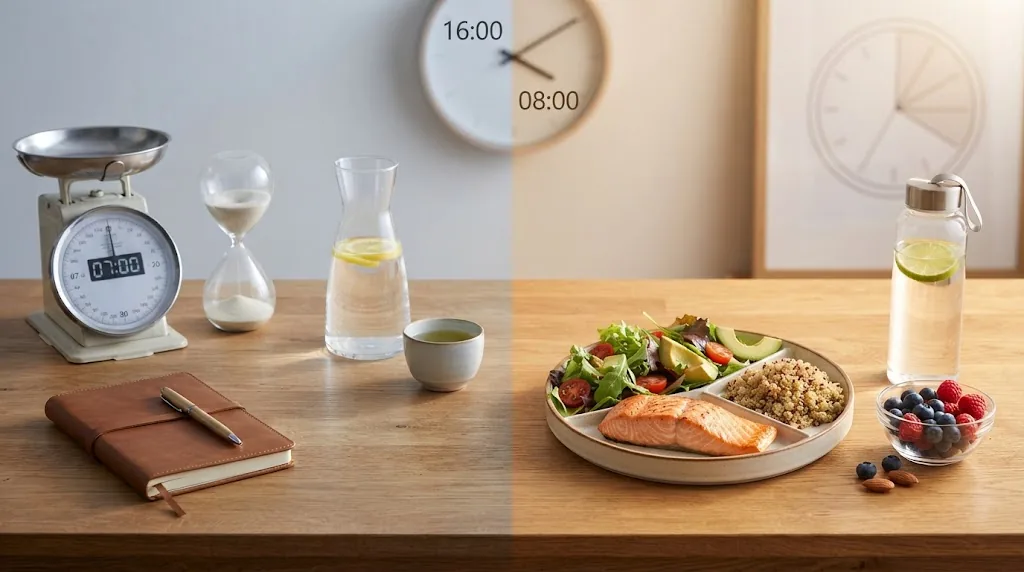
Intermittent fasting means eating during certain hours and not eating the rest of the time. The most popular schedule is 16/8: a 16-hour break and an 8-hour eating "window". For example, you eat from 12:00 to 20:00, and from 20:00 until noon the next day you have only water, tea and coffee without sugar.
Many people lose weight on it, and it's not a placebo. But the reason isn't that the body "switches into fat-burning mode" after hour 14, as social media claims. The reason is much simpler: when you can only eat for 8 hours, you usually eat less. The late snack before bed, the second dinner, the sandwich grabbed on the way out in the morning all disappear.
Research confirms this: compare fasting with an ordinary deficit of the same calories, and the result is nearly identical. Fasting isn't magic, it's a convenient way to eat less. Very convenient for some people, not at all for others.
The main schedules
| Schedule | How it works | Who it suits |
|---|---|---|
| 14/10 | 14 hours without food, a 10-hour window. For example, eating from 9:00 to 19:00 | Beginners: it's basically "don't eat at night" |
| 16/8 | 16 hours without food, an 8-hour window. For example, 12:00 to 20:00 | The most popular. Usually means skipping breakfast |
| 18/6 | 18 hours without food, a 6-hour window. For example, 13:00 to 19:00 | People who are used to 16/8 and feel good on it |
| 20/4 ("warrior diet") | 4 hours for all your food, essentially one big meal | Few people. Hard to get enough protein and not overeat |
| 5:2 | 5 days of normal eating, 2 non-consecutive days of 500-600 kcal | Those who find two hard days easier than every day |
| Alternate days | A normal day, then a day of 500 kcal or nothing | Hard to tolerate; most often abandoned |
It's best to start with 14/10 or 12/12 and move gradually. You can pick any hours for your window: if you're a night owl who likes a late dinner, shift it to 13:00-21:00. What matters is keeping it roughly the same every day.
16/8 for beginners: the first week
Most people who give up on 16/8 make the same mistake of jumping straight into sixteen hours without food, and after two miserable days they decide fasting isn't for them. It goes much more smoothly if you stretch the gap a little at a time over a week:
| Day | Eating window | What to do |
|---|---|---|
| 1-2 | 12 hours (8:00-20:00) | Just stop eating after 20:00. No snacks before bed |
| 3-4 | 10 hours (9:00-19:00 or 10:00-20:00) | Push breakfast an hour later. Drink water, tea or black coffee in the morning |
| 5-6 | 9 hours (11:00-20:00) | Breakfast becomes brunch. Make your first meal filling, with protein |
| 7 | 8 hours (12:00-20:00) | That's 16/8. Two main meals and one snack |
If a step feels very hard, stay on it for another 3-4 days. 14/10 is a perfectly workable schedule too, and much better than a 16/8 you'll drop after a week.
Why people lose weight on fasting: what the research shows
Intermittent fasting has been studied more than many people realise. In 2022 the New England Journal of Medicine published a trial by Deying Liu of Nanfang Hospital in Guangzhou, in which 139 people with obesity kept the same calorie deficit for a year, one group eating only between 8 a.m. and 4 p.m. and the other whenever they liked. After a year the first group had lost about 8 kg and the second 6.3 kg, a difference that wasn't statistically significant. Without counting calories the effect can be very small. In the TREAT trial, published in JAMA Internal Medicine in 2020, 116 people followed 16/8 for three months without limiting calories and lost under a kilogram, almost the same as a control group eating normally, and a noticeable share of what they lost was muscle.
Michelle Harvie in Manchester compared two 650 kcal days a week with a daily moderate deficit in overweight women, and after six months both groups had lost about the same, 5-6 kg. Alternate-day fasting is the hardest to stick with: in John Trepanowski's 2017 study it produced the same weight loss as a daily deficit, but more people gave up, 38% against 29%.
So intermittent fasting isn't a separate way to lose weight but a convenient package for a calorie deficit. If it's easier for you to skip food until lunch than to leave half your plate every time, it suits you, and if by evening the hunger has you ready to empty the fridge, it doesn't. There's some evidence of metabolic benefits too, with better insulin sensitivity and lower blood pressure in some people, but most of these effects come with weight loss and have been studied less in humans than in mice.
The main mistake: "anything goes in the window"
The most popular myth is that you can eat anything in any amount during the window and fasting will do the rest. It won't.
Eight hours is a long time. In eight hours you can easily eat 3,000 kcal: a big lunch, a snack with nuts, dinner, dessert. Especially when, after 16 hours without food, your body demands compensation. Many people who "do 16/8 and don't lose weight" overeat by 500-1,000 kcal in the window without even noticing.
So fasting and calorie counting aren't rivals but allies. Fasting helps you avoid extra food in the evening and morning; counting helps you avoid overeating in the window. Find your target in the calculator and make sure your weekly average stays below it. Exactly how much to eat for weight loss is covered in How many calories a day do you need to lose weight.
What to eat in an 8-hour window
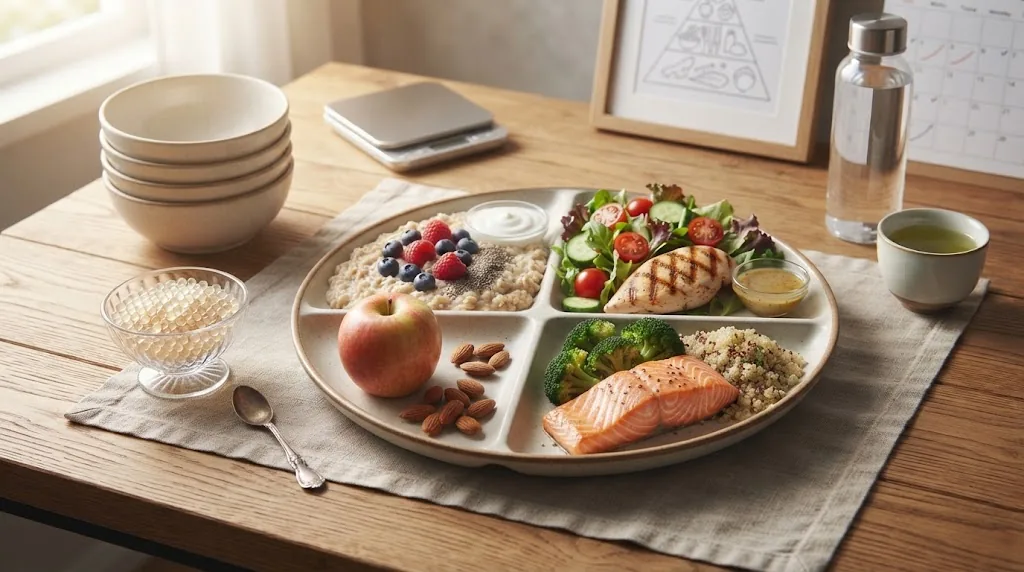
A good 16/8 window is two proper meals and one snack. A sample day of about 1,400 kcal:
| Time | Meal | Example | kcal | Protein, g |
|---|---|---|---|---|
| 12:00 | First meal, filling | 3-egg omelette with vegetables, wholegrain bread 40 g, 5% cottage cheese 100 g | 530 | 42 |
| 16:00 | Snack | Greek yoghurt 140 g, an apple, a 20 g handful of nuts | 300 | 18 |
| 19:30 | Dinner | Buckwheat 180 g, chicken breast 150 g, vegetable salad with a spoon of oil | 545 | 46 |
| Total | 1,375 | 106 |
Principles:
- Make the first meal protein-rich. After 16 hours without food you'll crave sweets and fast carbs. Protein and fibre keep you full for longer and help you not overeat in the evening.
- Protein at every meal. Muscle is lost more easily when fasting, especially with little protein. Aim for 1.2-1.6 g per kilogram of body weight. More in Dietary protein: recommended intake and sources.
- Vegetables and fibre. They add volume and fullness with few calories.
- Don't turn your last meal into a feast "for the next 16 hours". It's a common mistake: fear of hunger makes you eat more than you need.
Common mistakes
- Overeating in the window. The main mistake, see above. Fixed by counting calories, at least for the first 2-3 weeks.
- Too sharp a start. Jumping straight to 18/6 or 20/4 is a road to breakdown. Start with 12/12 or 14/10.
- Too little protein. Two meals of pasta and sandwiches, and muscle goes along with fat.
- Too little water. Part of our water comes from food. With less food, you need to drink more. You can work out your target in the water calculator.
- Training on an empty stomach when you're not used to it. Some people are fine, but if you feel dizzy, move your workout into the window or the window around your workout.
- Expecting a miracle. If your average calories haven't changed, neither will your weight, because the clock alone doesn't burn fat.
How to combine fasting with calorie counting
Fasting answers the question of when to eat and counting answers how much, and they work better together than apart. The easiest way is to keep your diary as usual, photograph every plate during your window and check the day's total in the evening: if the window held 1,500 kcal against a 1,600 target, all is well, and if it held 2,400, you know the problem isn't fasting but quantity. The MyFoodMate AI diary shows how much you ate each day and at which meals, the Progress screen shows your weekly average, and within a couple of weeks it's clear whether your schedule works. If the average is below target and your weight is falling, carry on, and if not, look at calories rather than the clock.
Who shouldn't fast
Anyone on insulin or diabetes tablets shouldn't start fasting without a doctor, because blood sugar can drop into hypoglycaemia. It isn't for pregnancy or breastfeeding either, and for anyone with a current or past eating disorder, strict windows easily set off the starve-binge-guilt cycle. Teenagers and older people with low body weight, people with stomach trouble or medicines that must be taken with food, and those doing heavy physical work or professional sport should talk to a doctor first. And if fasting leaves you dizzy, seeing spots, sleeping badly or thinking about food all the time, it's better to stop than to push through.
The idea itself isn't new. In 2019 Rafael de Cabo and Mark Mattson summed up nearly a century of research in a review for the New England Journal of Medicine and concluded that intermittent fasting is a workable way to eat less, but by no means a magic one, which fits neatly with what the trials above found.
Sources
- Liu D et al. Calorie restriction with or without time-restricted eating in weight loss. New England Journal of Medicine, 2022.
- Lowe DA et al. Effects of time-restricted eating on weight loss and other metabolic parameters in women and men with overweight and obesity: the TREAT randomized clinical trial. JAMA Internal Medicine, 2020.
- Harvie MN et al. The effects of intermittent or continuous energy restriction on weight loss and metabolic disease risk markers: a randomized trial in young overweight women. International Journal of Obesity, 2011.
- Trepanowski JF et al. Effect of alternate-day fasting on weight loss, weight maintenance, and cardioprotection among metabolically healthy obese adults: a randomized clinical trial. JAMA Internal Medicine, 2017.
- de Cabo R, Mattson MP. Effects of intermittent fasting on health, aging, and disease. New England Journal of Medicine, 2019.

We check blog materials against current WHO recommendations.