Contents
First, the main point
If you count calories, eat "below your target" and the weight still won't move, the reason is almost certainly one of two things: you eat more than you think, or you burn less than you think. That sounds harsh, but it's actually good news, because both can be found and fixed, and neither means there's anything wrong with you. Below are the seven most common reasons, each with a number for how many calories it usually eats out of your deficit. Two or three of these small things are enough to wipe out a 400 kcal deficit.
"I don't eat and don't lose weight" - is that possible?
If "don't eat" really means very few calories, then no, the laws of physics apply in the kitchen too, and a body short of energy takes what it needs from its reserves. There's no metabolism that holds 90 kg for years on 1,000 kcal a day. But "I don't eat" almost never means "I eat few calories". More often it means "I eat rarely", "I don't eat anything unhealthy" or "I don't eat after six", and you can easily skip breakfast, have a salad for lunch and then put away 1,500 kcal of nuts, cheese and bread over an evening chat in the kitchen while honestly believing you hardly ate.
In 1992 Steven Lichtman at Columbia University took people who complained they couldn't lose weight on under 1,200 kcal and measured what they really ate and burned. They turned out to eat about 2,000 kcal on average, underreporting their food by 47% and overstating their activity by 51%. None of them was lying, the brain is just bad at remembering food that wasn't a "meal". If you truly eat very little and haven't lost weight for a long time, it's worth getting your thyroid checked and talking to a doctor about your medicines, since some affect weight and appetite, but an honest week of logging is still the place to start.
Hidden calories - up to 300-500 kcal a day
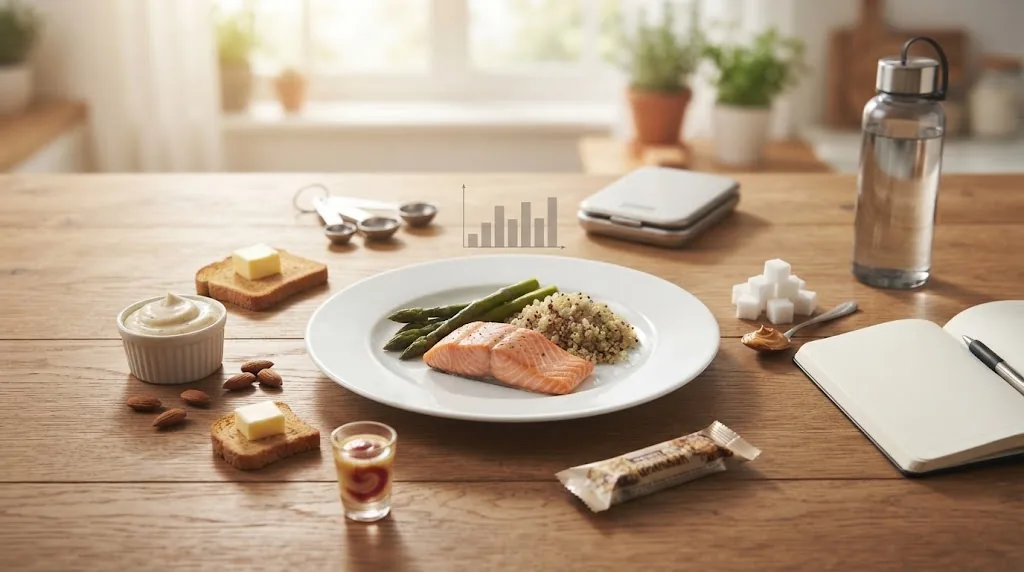
The most common culprit is what we eat but don't count as food:
| What | How much | kcal |
|---|---|---|
| Sunflower oil in the pan | 1 tablespoon | 135 |
| Butter in porridge | a 10 g knob | 75 |
| Mayonnaise in salad | 1 tablespoon | 100 |
| 15% sour cream in soup | 1 tablespoon | 40 |
| Sugar in tea or coffee | 2 teaspoons | 55-60 |
| Latte, 300 ml | 1 cup | 110-150 |
| Juice | a 200 ml glass | 90 |
| Cola | 0.5 l | 210 |
| Glass of wine | 150 ml | 110-130 |
| "A small handful" of nuts | 30 g | 170-200 |
| Biscuits with tea | 2 pieces | 100-150 |
| Tasting while cooking, finishing the kids' plates | per day | 100-200 |
Add up an ordinary day, oil in the pan, two coffees with milk and sugar, a handful of nuts at work and a couple of biscuits in the evening, and there are 600 kcal you probably won't remember. Each thing on its own feels trivial, "a spoon of oil isn't food", yet a tablespoon of oil has as many calories as a whole apple and half a banana. So it pays to log everything liquid, fatty and sweet on a separate line for at least three days, even if it's "just a little", and to measure oil with a spoon instead of pouring it from the bottle.
Weekends - up to 3,000 kcal a week
On weekdays everything goes to plan, breakfast, a packed lunch, dinner, and then on Friday night there's pizza with friends, a restaurant on Saturday and a barbecue at the dacha on Sunday. In 2008 Susan Racette at Washington University in St. Louis followed dieters for a year and saw that they lost weight only from Monday to Friday and stalled or even gained at weekends. The arithmetic is unkind: a 400 kcal deficit over five weekdays gives 2,000 kcal, and two weekend days at 1,000 kcal over target cancel the whole week, though 1,000 kcal is only two slices of pizza, a glass of wine and dessert. If your weekdays are perfect but your weekly average doesn't reach a deficit, that's your answer, and the fix isn't a ban but a buffer: eat 100-200 kcal less on weekdays so there's room at the weekend.
Mixing up raw and cooked weight - up to 200-400 kcal
100 g of dry pasta has about 350 kcal, 100 g of cooked pasta about 140, so if you weigh 200 g of cooked pasta and log it as dry, you're off by 400 kcal. It can go the other way too, and then you undercount. The same happens with grains, rice and meat, since grains soak up water and get 2.5-3 times heavier when cooked while meat loses water when fried, though the calories in the portion don't change. The thing to watch is which line you pick in the database: cooked for cooked, dry for dry.
Overestimated exercise - 200-400 kcal
You work out for an hour, your tracker says 600 kcal, and you eat extra with a clear conscience, though the tracker was almost certainly wrong. In 2017 Stanford researchers tested seven popular wristbands and found they measured heart rate reasonably well but energy use with errors from 27% for the best to 93% for the worst, and none came within 20%. The tracker also counts every calorie burned during the session, including the ones you'd have burned on the sofa anyway, while the real extra from an hour in the gym is 200-400 kcal for most people. On top of that we unconsciously eat more and move less for the rest of the day after training, and in a 2012 review by Diana Thomas this compensation explained why people lose less than the exercise calculations promise. So don't add workouts to your target by hand; choose an honest activity level once in the calculator and count only food.
Water retention - masks 1-2 kg
Sometimes you do everything right, the fat goes, and the scale doesn't show it. A salty dinner, a new workout after which muscles hold water to recover, poor sleep, stress or the second half of the menstrual cycle can keep an extra 0.5-2 kg on the scale for days, sometimes a couple of weeks, while the fat under that water keeps going. It's especially common when people start going to the gym, and for the first two or three weeks the weight may even rise though jeans already fit looser. Weigh yourself under the same conditions, in the morning on an empty stomach after the toilet, look at the weekly average rather than one morning, and measure your waist once a week, since centimetres don't hoard water the way the scale does; more in the guide Weekly averages.
Too big a deficit - breakdowns eat everything
Oddly enough, people often lose weight worse on a very strict diet than on a moderate one. It's almost impossible to last long on 1,000-1,200 kcal, the hunger builds, and sooner or later comes a breakdown, an evening, a weekend or a whole week when everything saved gets eaten and more. A big deficit also makes the body economise, moving less, flagging and drifting to the sofa, so the deficit melts away on its own. If your diary looks like "five perfect days at 1,100, then two days at 3,000", raise your calories by 200-300 and compare the average two weeks later, which usually comes out lower than before. A pace you can keep up is covered in How much weight you can safely lose in a month.
Too short a time - you need 2-3 weeks
Many people give up after a week or two, deciding nothing works. But with a 300-500 kcal daily deficit you lose 0.3-0.5 kg of fat a week, while water swings by 1-2 kg in a day, so a week of honest fat loss easily hides behind one salty dinner. The real trend shows after two or three weeks at the earliest, and you need to compare an average week with an average week rather than one morning with another: if your average weight in week three is lower than in week one, it's working, even if the scale showed a plus yesterday.
How to check yourself in a week
If you can't tell which reason is yours, treat a week as an experiment. For seven days log absolutely everything, including oil, drinks, tastes and weekends, and measure oil with a spoon. Weigh yourself every morning under the same conditions without drawing conclusions from any single day, and don't add tracker calories to your target. On day eight look at your average calories and weight for the week, compare them with the target from the calculator and find the three biggest sources of calories you hadn't thought about, which almost always turn up.
If after two or three weeks of honest counting your average is below target and your average weight isn't changing, the formula has overestimated your energy use, which happens, since formulas are off by about ten percent either way. Then take off another 150-200 kcal. If you keep your diary in MyFoodMate AI and weigh yourself regularly, the app spots the mismatch itself and suggests adjusting your target, as described in the guide Recalculating your target. How a deficit works and why the week matters more than the day is covered in A calorie deficit without relapses.
Sources
- Lichtman SW et al. Discrepancy between self-reported and actual caloric intake and exercise in obese subjects. New England Journal of Medicine, 1992.
- Racette SB et al. Influence of weekend lifestyle patterns on body weight. Obesity, 2008.
- Shcherbina A et al. Accuracy in wrist-worn, sensor-based measurements of heart rate and energy expenditure in a diverse cohort. Journal of Personalized Medicine, 2017.
- Thomas DM et al. Why do individuals not lose more weight from an exercise intervention at a defined dose? An energy balance analysis. Obesity Reviews, 2012.

We check blog materials against current WHO recommendations.