Contents
First: who 1,200 suits and who it doesn't
1,200 kcal a day is the most popular number in the weight-loss world and one of the most misunderstood. For one person it's a sensible deficit, for another a starvation diet after which the weight comes back with interest, and the difference comes down to height, weight, age and how much you move. It can work for a fairly short woman of up to 160-165 cm with a modest weight, especially if she sits at a desk all day or is over 45-50, when energy use is naturally lower.
Take a 50-year-old woman who is 158 cm tall, weighs 65 kg and works in an office. Her maintenance target is about 1,470 kcal, so 1,200 is a deficit of about 18%, moderate and quite safe. But a 30-year-old woman who is 170 cm, weighs 75 kg and goes to the gym needs about 2,050-2,300 kcal, and for her 1,200 means a 40-48% deficit. She'll manage it for a couple of weeks, lose muscle along with fat and almost certainly break down.
You can check your target in our calorie calculator, and how to turn it into a weight-loss number is covered in How many calories a day do you need to lose weight.
What a 1,200 kcal day looks like
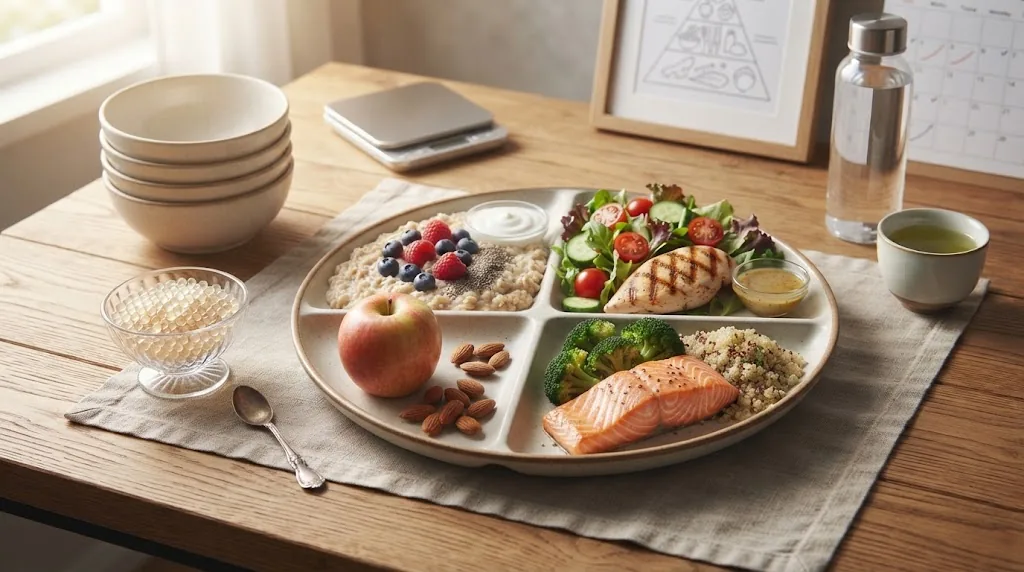
The main fear about 1,200 is being hungry all the time. That's true if you build the day from pastries and syrupy coffee: 1,200 kcal will run out by lunchtime. If you build it around protein and vegetables, you get four quite filling meals.
Here's a sample Monday. Weights are for cooked grains, raw meat and fish, and dry oats.
| Meal | On the plate | kcal | Protein, g | Fat, g | Carbs, g |
|---|---|---|---|---|---|
| Breakfast | Porridge: 50 g oats in 150 ml of 2.5% milk, 80 g berries, a teaspoon of honey | 305 | 11 | 7 | 48 |
| Lunch | Buckwheat 180 g, chicken breast 130 g, 100 g each of cucumber and tomato, a teaspoon of oil | 425 | 40 | 10 | 45 |
| Dinner | Steamed pollock 180 g, broccoli 200 g, a teaspoon of oil, a 20 g slice of rye bread | 279 | 36 | 8 | 15 |
| Snack | 2% Greek yoghurt, 140 g, and an apple | 173 | 14 | 3 | 20 |
| Total | 1,182 | 101 | 28 | 128 |
Notice that this day has over 100 g of protein, half a kilo of vegetables and fruit, grains and even honey. It isn't a "water diet", just normal food in slightly smaller portions.
A weekly menu: the table
Each day is about 1,200 kcal and 85-115 g of protein. The dishes are simple and it's ingredients that repeat, not whole meals: easier to shop for and less boring.
| Day | Breakfast | Lunch | Dinner | Snack | kcal | Protein, g |
|---|---|---|---|---|---|---|
| Mon | Porridge with milk (50 g oats), berries and honey | Buckwheat 180 g, chicken breast 130 g, vegetables | Pollock 180 g, broccoli 200 g, a slice of rye bread | Greek yoghurt 140 g, apple | 1,182 | 101 |
| Tue | 2 boiled eggs, wholegrain bread 40 g, cheese 10 g, tomato | Borscht 350 g with sour cream, rye bread 40 g | Turkey 150 g, braised cabbage with carrot | 1% kefir 250 ml, apple | 1,187 | 85 |
| Wed | 5% cottage cheese 180 g, berries 100 g, honey 10 g | Rice 180 g, cod 180 g, cucumbers | 2-egg omelette with courgette and pepper, wholegrain bread 30 g | Mandarins 150 g, 1% kefir 200 ml | 1,203 | 95 |
| Thu | Porridge with milk (50 g oats) and banana | Buckwheat with chicken, 300 g | Salad: tuna 100 g, egg, cucumber, tomato, 2 tsp oil | 1% kefir 250 ml, apple | 1,188 | 84 |
| Fri | 2 eggs, cheese 20 g, wholegrain bread 40 g, cucumber | Lentils 180 g, chicken breast 120 g, cabbage salad | 5% cottage cheese 180 g with cucumber and tomato | Apple, Greek yoghurt 140 g | 1,198 | 116 |
| Sat | 5% cottage cheese 150 g with 10% sour cream and banana | Cabbage rolls 280 g with sour cream, rye bread 40 g | Salmon 120 g, broccoli 200 g, lemon | Greek yoghurt 140 g, berries | 1,188 | 95 |
| Sun | 2-egg omelette with tomato, wholegrain bread 30 g | Shchi (cabbage soup) 350 g, chicken breast 100 g, rye bread 30 g | Turkey 130 g, boiled potatoes 200 g, cucumber | 1% kefir 250 ml, berries, mandarin | 1,186 | 99 |
Macros are calculated from reference data; weights are per serving. If you want to check a whole dish, our catalog breaks down borscht, buckwheat with chicken and cabbage rolls by portion and cooking method.
To swap dishes, trade a food for another from the same group, chicken for turkey or fish, buckwheat for rice or bulgur, cottage cheese for Greek yoghurt, and the calories shift by 20-50 kcal while the protein stays put. Swapping chicken for pork or fatty cheese is where it goes wrong, adding 100-200 kcal per serving.
How much protein you can get
On 1,200 kcal protein is the main concern, because the fewer calories you eat, the more readily the body burns muscle along with fat, and protein is what prevents it. The menu above gives 85-115 g of protein a day, 29-39% of calories, which for a woman of 65-70 kg is about 1.2-1.8 g per kilogram, exactly what's recommended for keeping muscle while losing weight. More on protein targets and sources is in Dietary protein: recommended intake and sources. On 1,200 kcal there's only one way to get that much: every meal needs a protein food, and a breakfast of plain porridge without cottage cheese or eggs won't get you there.
The best-value foods are those with plenty of protein and few calories, and almost all of them are sold in any supermarket:
| Food | Serving | Protein, g | kcal |
|---|---|---|---|
| Chicken breast | 130 g raw | 31 | 147 |
| Pollock | 180 g raw | 29 | 130 |
| 5% cottage cheese | 180 g | 31 | 218 |
| 2% Greek yoghurt | 140 g | 14 | 102 |
| Turkey | 150 g raw | 36 | 171 |
| Eggs | 2 | 14 | 172 |
How not to go hungry on 1,200
Even with a good menu the first week or two can feel strange, and protein is what helps most. In 2005 David Weigle at the University of Washington in Seattle put volunteers on a diet where protein made up 30% of calories and let them eat as much as they liked, and with no rules at all they ended up eating almost 450 kcal a day less. Vegetables help through volume, as 200 g of broccoli is just 70 kcal and makes the plate look full, since your stomach counts grams rather than calories. Soup works the same way, with a 350 g bowl of borscht giving about 320 kcal and hours of fullness. Calories in a glass, on the other hand, barely fill you up: a glass of juice is 90 kcal of your budget with no satiety, and the same goes for sweet coffee and soda.
Four meals a day work better than two, because if you wait from breakfast to dinner, by evening the hunger will beat any willpower. And get your sleep: when Karine Spiegel at the University of Chicago cut young men's sleep to four hours for two nights, their levels of the hunger hormone ghrelin rose by almost a third and their craving for sweets and starchy food grew noticeably.
If after two weeks you're still constantly hungry, irritable, sleeping badly or overeating in the evenings, 1,200 is too little for you. Add 150-200 kcal, preferably from protein. You'll lose weight a bit more slowly, but you'll reach your goal. On a safe pace, see How much weight can you safely lose in a month.
How to stick to this menu without slipping
At 1,200 kcal there's little room for error. An extra spoon of oil in the pan is 135 kcal, more than 10% of the whole day. That's why at low calories it's especially important to log everything, including oil and drinks.
The easiest way is to photograph every plate before eating: the app breaks down the composition and macros, and if something's off you correct it in words. If your menu repeats, you can save dishes and add them with one tap.
Sources
- Skurikhin IM, Tutelyan VA. Tables of the chemical composition and caloric value of Russian food products. Moscow: DeLi Print, 2007.
- Weigle DS et al. A high-protein diet induces sustained reductions in appetite, ad libitum caloric intake, and body weight despite compensatory changes in diurnal plasma leptin and ghrelin concentrations. American Journal of Clinical Nutrition, 2005.
- Spiegel K et al. Sleep curtailment in healthy young men is associated with decreased leptin levels, elevated ghrelin levels, and increased hunger and appetite. Annals of Internal Medicine, 2004.

We check blog materials against current WHO recommendations.