Contents
20 to 115 kcal per piece
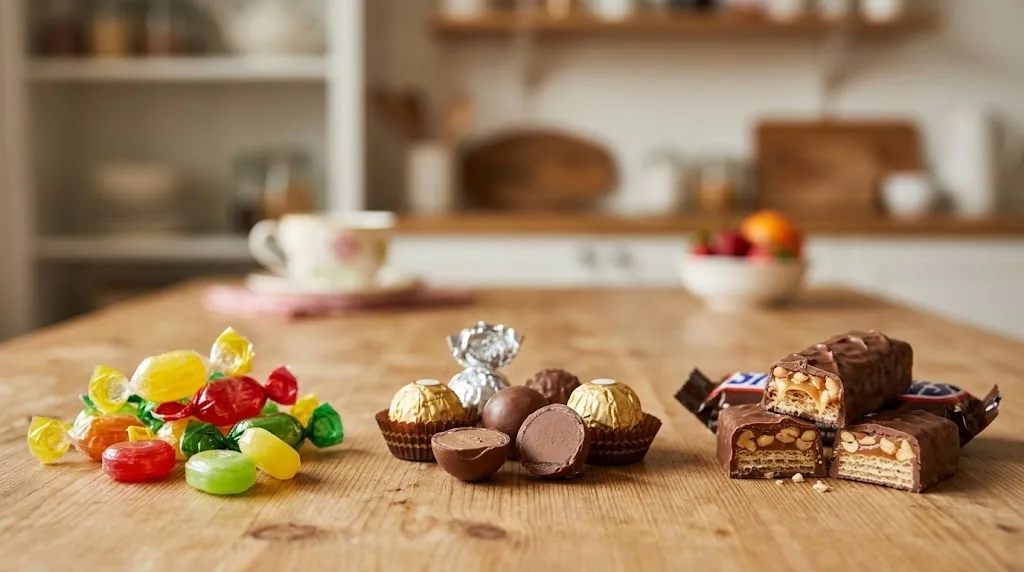
The sweets in the office bowl all look equally harmless, but there's a fivefold gap between them, and it comes down to weight and whether there's chocolate and nuts inside. A hard candy is 20-30 kcal, toffee, milk fudge and jelly sweets 30-45, a soy bar of the kind Russians know from the Rot Front wrapper 65-90, and a chocolate with a wafer or praline filling 90-115 kcal. Per 100 g nearly all of them land between 370 and 570 kcal, so the useful question isn't "which candy" but "how big".
Table: calories in candy by type
The figures are averages from reference tables and the labels of mass-market Russian sweets, and since piece weights differ from factory to factory, the table gives ranges:
| Type of candy | kcal per 100 g | Weight of 1 piece | kcal per piece |
|---|---|---|---|
| Hard candy | 370-390 | 5-6 g | 20-23 |
| Filled hard candy | 370-400 | 6-8 g | 25-30 |
| Toffee | 380-450 | 6-8 g | 25-35 |
| Milk fudge | 360-400 | 8-12 g | 30-45 |
| Chocolate-covered jelly | 360-400 | 10-12 g | 40-45 |
| Chocolate-covered soufflé | 400-450 | 10-15 g | 45-65 |
| Chocolate-covered halva | 500-530 | 10-15 g | 55-75 |
| Truffle, praline | 530-570 | 10-15 g | 55-85 |
| Soy bar | 430-450 | 15-20 g | 65-90 |
| Mini bar with nougat and caramel | 470-490 | 15-20 g | 75-95 |
| Chocolate with a wafer layer | 520-540 | 18-22 g | 95-115 |
So two candies with your tea can be anything from 40 to 230 kcal, from a couple of hard candies at the low end to a couple of wafer chocolates at the top, which is already a proper snack.
How to find the calories of your candy in a minute
The bag nearly always gives calories per 100 g but rarely the weight of one piece, and the easiest thing is to find it yourself. Tip ten unwrapped candies onto the kitchen scales, divide the weight by ten and multiply by the label's calories divided by a hundred. If ten candies weigh 180 g and the bag says 530 kcal per 100 g, one candy weighs 18 g and has 18 × 530 / 100 = 95 kcal. Without scales you can estimate from the bag: a one-kilo bag of soy bars holds about 55-60 pieces, so each weighs 17-18 g. And if you weigh them wrapped, take off 0.5-1 g per wrapper, which on small hard candies is as much as 15% of the weight.
"Sugar-free" does not mean calorie-free
Candies made with maltitol, isomalt and other sweeteners are usually only 10-25% lighter than regular ones, since sugar alcohols give about 2.4 kcal per gram against 4 for sugar, and the fat in the chocolate and nuts is still there. A sugar-free chocolate candy still comes to 400-500 kcal per 100 g.
One more detail: in larger amounts (usually 20-50 g at a time) sugar alcohols cause bloating and a laxative effect. The packet says so honestly, in small print.
How many candies you can have while losing weight
If candy fits into your daily calorie target, it does not stop weight loss. Two or three hard candies with tea are 50-70 kcal, about the same as one small apple. Trouble starts when candy is eaten from the bowl without counting: ten soy bars in a day is 750 kcal, a third of many women's target on a deficit.
What helps in practice:
- Keep the bowl out of sight. Candy in a cupboard gets eaten much less often than candy on the table.
- Choose small ones. A 25 kcal hard candy satisfies the "something sweet" urge too.
- Eat it after a meal, not instead of one. Sweets on an empty stomach are less filling and more often lead to another.
- Log it right away. Candy is a classic source of "hidden calories" that are simply forgotten by evening.
Why sweets fill you up so poorly is easy to see from the FoodMate Score: candy is energy-dense with almost no protein or fibre, so its score is low even when the portion is small.
How to log candy painlessly
In MyFoodMate AI you can take a photo of the candies or just write "two wafer chocolates" or "three hard candies". The app fills in an average weight and counts. If you always eat the same sweets, weigh them once, correct the grams and add them to favorites: after that they go in without a photo or corrections. How to correct grams is covered in Editing portion weights.

We check blog materials against current WHO recommendations.