Calories per serving
| Serving | Kcal | P | F | C |
|---|---|---|---|---|
| Teaspoon, 7 g | 41 | 1.8 | 3.5 | 1.0 |
| Tablespoon, 16 g | 94 | 4.0 | 8.1 | 2.2 |
| For a toast, 20 g | 118 | 5.0 | 10.1 | 2.8 |
| 100 g | 588 | 25.1 | 50.4 | 13.9 |
| 340 g jar | 1,999 | 85.3 | 171.4 | 47.3 |
Your plate isn't the average one
The table shows average reference values. Take a photo of your plate: we will count the composition, macros and FoodMate Score of exactly your serving. Free, no sign-up, the photo is not stored.
Drop a food photo here
Or choose a file from your computer. A regular top-down photo of the plate in daylight works best.
FoodMate Score of the food
This is a score for the food on its own, by its composition per 100 g, using the same formula the app applies to a meal. On a plate with other foods the result will differ: buckwheat with vegetables scores higher than buckwheat alone.
How it changes with different cooking methods
| Version | Serving |
|---|---|
| 100% peanuts, no sugar | 94 kcal |
| With sugar and oil | 96 kcal |
| Crunchy | 94 kcal |
| Toast: 30 g bread, 16 g peanut butter, half a banana | 226 kcal |
Micronutrients
Values for a standard serving, as a percentage of the daily value for an adult.
| Nutrient | Per serving | % DV |
|---|---|---|
| Vitamin E | 1.5 mg | 10% |
| Niacin (B3) | 2.1 mg | 11% |
| Manganese | 0.2 mg | 10% |
| Magnesium | 26.9 mg | 6% |
How many calories are in a spoon of peanut butter
Peanut butter made from peanuts only has about 588 kcal per 100 g: 25 g of protein, 50 g of fat, 14 g of carbs and 6 g of fiber. A level tablespoon weighs about 16 g and gives 94 kcal, a teaspoon about 7 g and 41 kcal. A heaped spoon easily holds 25-30 g, and that is already 150-175 kcal. A 340 g jar is 2000 kcal, almost a daily requirement.
Sugar-free and sweetened peanut butter
Many people choose sugar-free peanut butter for the calories, but the difference is small: sugar and oil change the number by 10-20 kcal per 100 g. The ingredients matter more: a good peanut butter has only peanuts and maybe salt. Cheap ones add sugar, palm or hydrogenated oil, and have less protein. A layer of oil on top of natural peanut butter is normal, just stir it in.
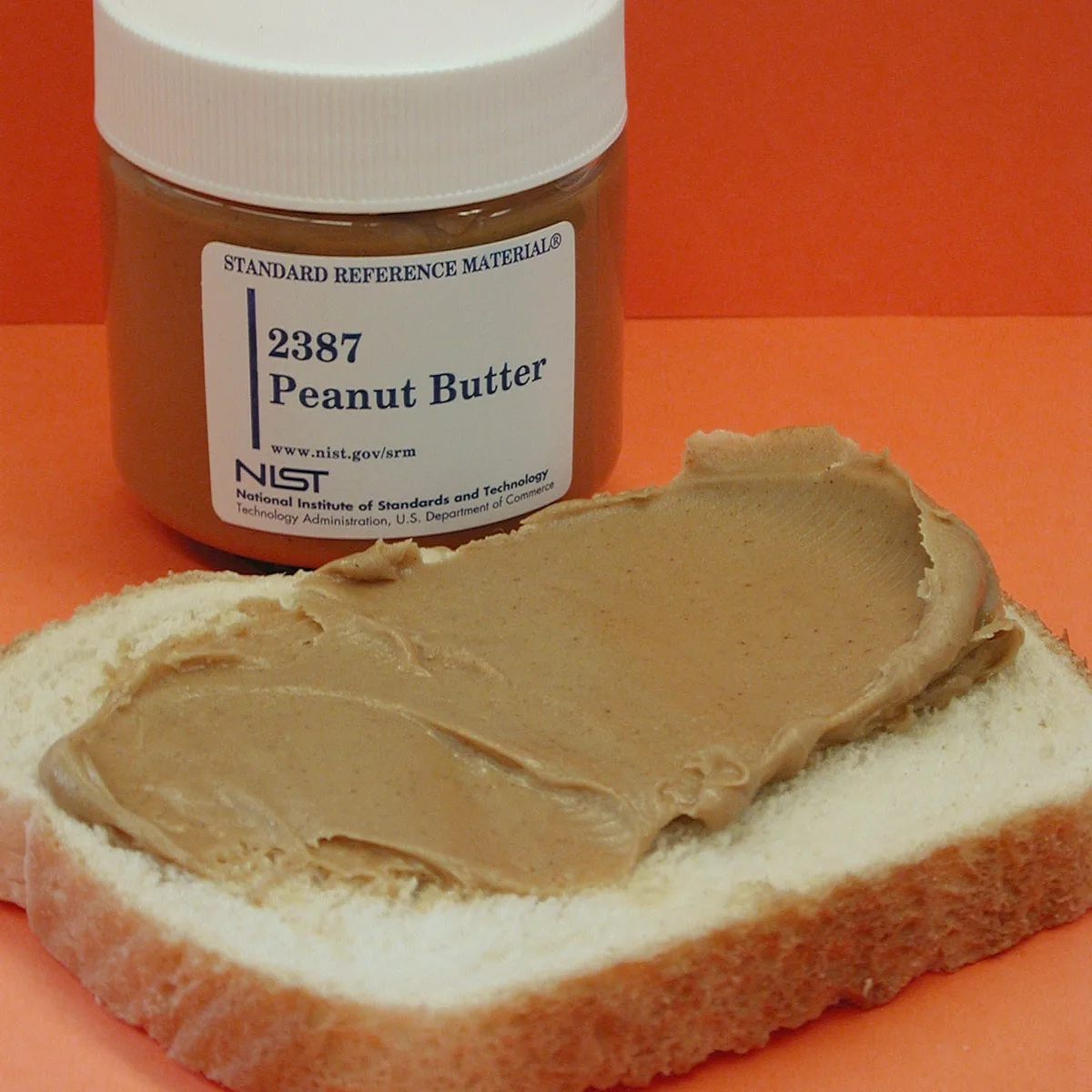
Peanut butter toast
A 30 g slice of bread, a tablespoon of peanut butter and half a banana are about 226 kcal and 8 g of protein. It is a filling breakfast or a pre-workout snack. Peanut butter works well in oatmeal too: a spoon makes the porridge more filling thanks to fat and protein. Just measure with a spoon instead of spreading by eye: a layer on toast easily comes to 30 g.
Peanut butter for weight loss
Peanut butter does not stop weight loss if you eat it by the spoon, not by the jar. One or two spoons a day give 94-188 kcal, vitamin E, niacin and some protein. The trouble is that it is easy to eat straight from the jar and quietly reach 300-400 kcal. If that is you, buy small jars or 15-20 g single-serve packs.
How to count your serving
The most accurate way is to weigh it: put the jar on the scale, take what you need and look at the difference. If the peanut butter is on toast, in porridge or a smoothie, take a photo in MyFoodMate AI and the app counts everything together.