Contents
How much fiber do you need per day?
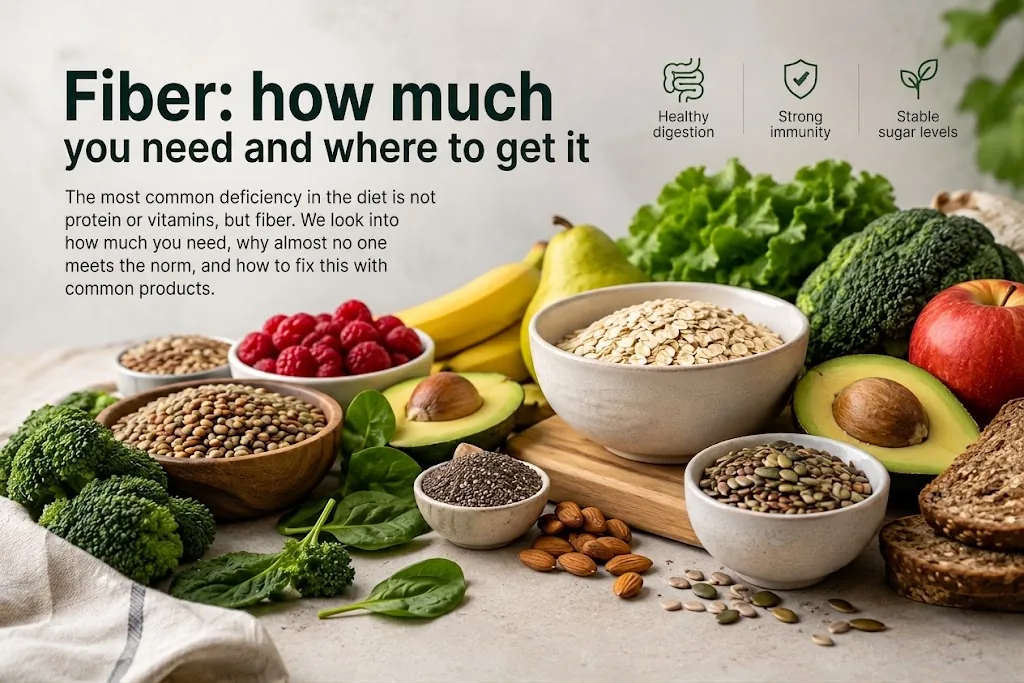
The World Health Organization advises adults to eat at least 25 g of fiber a day. A more practical way is to tie it to calories, at about 14 g for every 1,000 kcal, so on a 1,980 kcal diet you'd need around 28 g.
Fiber isn't digested and gives no calories, yet it keeps your bowels working, keeps you full and keeps blood sugar steady after a meal. In the FoodMate Score it makes up 20% of a meal's rating, the same weight as protein.
On average people get 12-15 g of fiber a day, about half of what they need. It is the most common gap in the diet, and also the easiest one to close.
Why most people don't get enough
The reason is simple enough: fiber lives in the very foods that tend to disappear from the menu first, such as whole grains, beans and lentils, vegetables, fruit eaten with the skin and whole-grain bread. The more ready meals and refined foods you eat, the less fiber you get for the same number of calories.
You can see this in the food diary within the first week, when calories and protein are on target and the fiber bar is only a third full. It's the picture we see most often in people who have just started logging their food.
Where to find fiber
It's more reliable to lean on ordinary food than on supplements from the pharmacy. Beans and lentils lead the way, with about 7 g of fiber in 100 g of boiled beans. Next come whole grains, as buckwheat, oatmeal, bulgur and pearl barley give 3-5 g per 100 g of cooked porridge. Cabbage, carrots, broccoli and beetroot have 2-3 g per 100 g, and an apple eaten with the skin gives 2.4 g, close to a handful of almonds with about 3.5 g.
Table: fiber content in foods
The figures below come from food composition tables and are per 100 g of the food as it is eaten:
| Food item, 100 g | Fiber | kcal |
|---|---|---|
| Red kidney beans, boiled | 7.4 g | 93 |
| Lentils, boiled | 7.9 g | 116 |
| Rolled oats, dry | 10.1 g | 366 |
| Buckwheat, boiled | 2.7 g | 92 |
| White cabbage | 2.0 g | 28 |
| Carrots | 2.4 g | 35 |
| Apple with skin | 2.4 g | 52 |
| Whole-grain bread | 6.8 g | 247 |
| Almonds | 12.5 g | 579 |
How to reach your daily target
You don't have to change your whole diet, as four spots in the day are enough. Cooking oatmeal or buckwheat for breakfast instead of white toast already gives 3-5 g. Beans or lentils in a soup or as a side add about 7 g more, two vegetable sides over the day give 4-6 g, and an apple with a handful of nuts as a snack brings about 5 g, which adds up to roughly 25 g. Here is what that can look like on an ordinary day:
| Meal | What to add | Fiber |
|---|---|---|
| Breakfast | Oatmeal (60 g dry flakes) | 6.1 g |
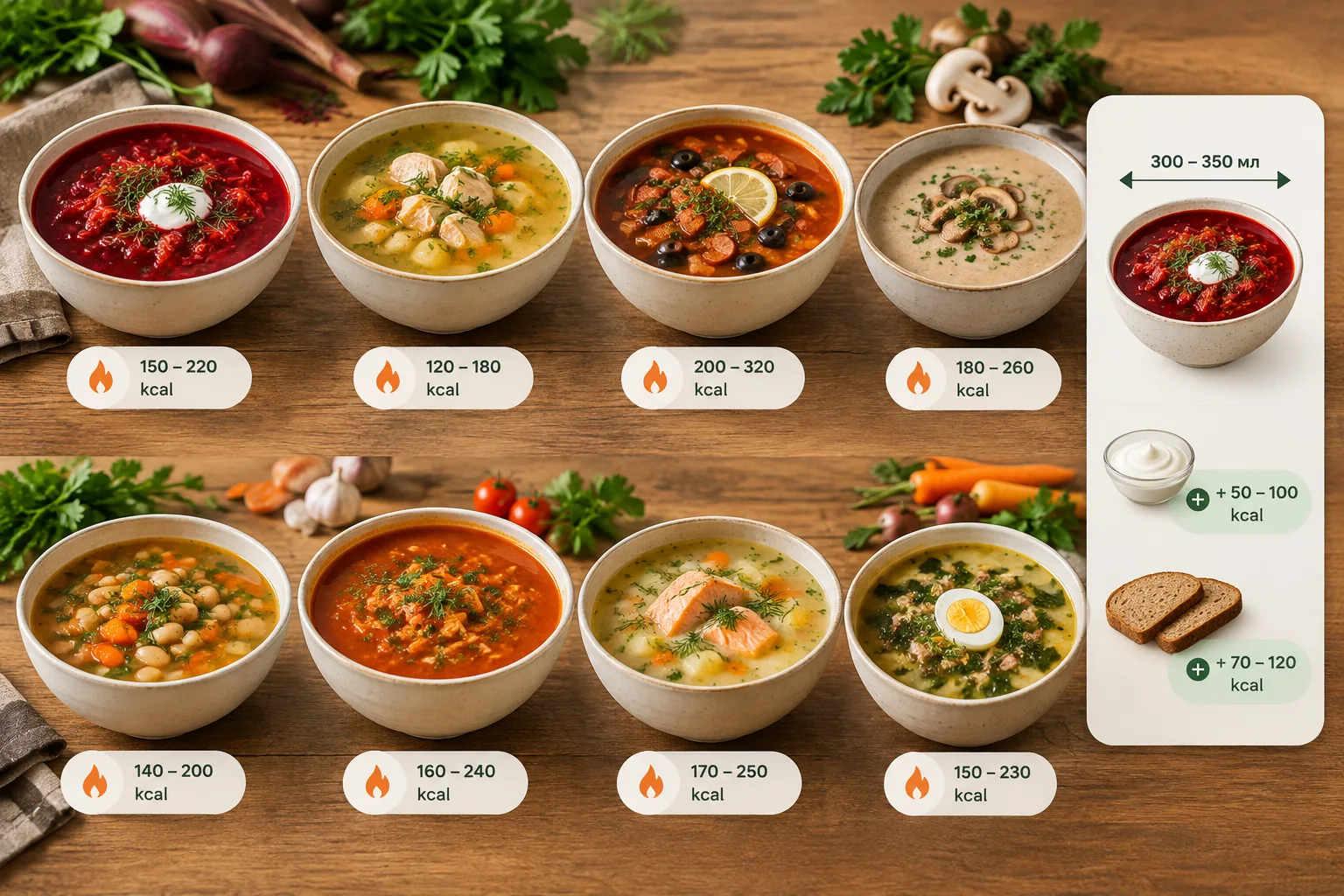
| Lunch | Borscht with beans (350 g serving) | 7.2 g |
| Side dish | Buckwheat (150 g) + cabbage salad | 5.7 g |
| Snack | Apple + almonds (20 g) | 4.9 g |
What happens if you increase it too fast
If you eat about 12 g of fiber now and jump to 30 g on Monday, your stomach will almost certainly protest with bloating, because gut bacteria need time to get used to the new food. Go up by about five grams a week and drink more water. Pharmacies know this well: the leaflet for psyllium husk powder tells you to wash down every dose with a full glass of water, because without it the powder causes constipation rather than easing it.
With a bowel disease, irritable bowel syndrome or during a flare-up, the amount of fiber should be set by a doctor, since some kinds of fiber are restricted in these cases.
The bottom line
In 2019 The Lancet published a large review by Andrew Reynolds of the University of Otago that pulled together almost 250 studies on fiber. People who ate 25-29 g a day had the lowest rates of heart disease, diabetes and bowel cancer, which is exactly the amount most of us fall about half short of. You can get there without supplements, with oatmeal in the morning, beans in the soup and an apple instead of a biscuit, just over a couple of months rather than in a single day.

We check blog materials against current WHO recommendations.