Calories per serving
| Serving | Kcal | P | F | C |
|---|---|---|---|---|
| Tablespoon, 25 g | 21 | 0.8 | 0.1 | 3.6 |
| 100 g | 83 | 3.1 | 0.2 | 14.5 |
| Side serving, 150 g | 125 | 4.7 | 0.3 | 21.8 |
| Plate, 250 g | 208 | 7.8 | 0.5 | 36.3 |
Your plate isn't the average one
The table shows average reference values. Take a photo of your plate: we will count the composition, macros and FoodMate Score of exactly your serving. Free, no sign-up, the photo is not stored.
Drop a food photo here
Or choose a file from your computer. A regular top-down photo of the plate in daylight works best.
FoodMate Score of the food
This is a score for the food on its own, by its composition per 100 g, using the same formula the app applies to a meal. On a plate with other foods the result will differ: buckwheat with vegetables scores higher than buckwheat alone.
How it changes with different cooking methods
| Version | Serving |
|---|---|
| Boiled in water | 124 kcal |
| With butter (150 g and 10 g butter) | 200 kcal |
| Tabbouleh with herbs, tomato and olive oil | 180 kcal |
| Dry grain, 37 g (about 150 g cooked) | 127 kcal |
Micronutrients
Values for a standard serving, as a percentage of the daily value for an adult.
| Nutrient | Per serving | % DV |
|---|---|---|
| Manganese | 0.9 mg | 45% |
| Magnesium | 48 mg | 11% |
| Iron | 1.4 mg | 10% |
| Niacin (B3) | 1.5 mg | 8% |
Calories in dry and cooked bulgur
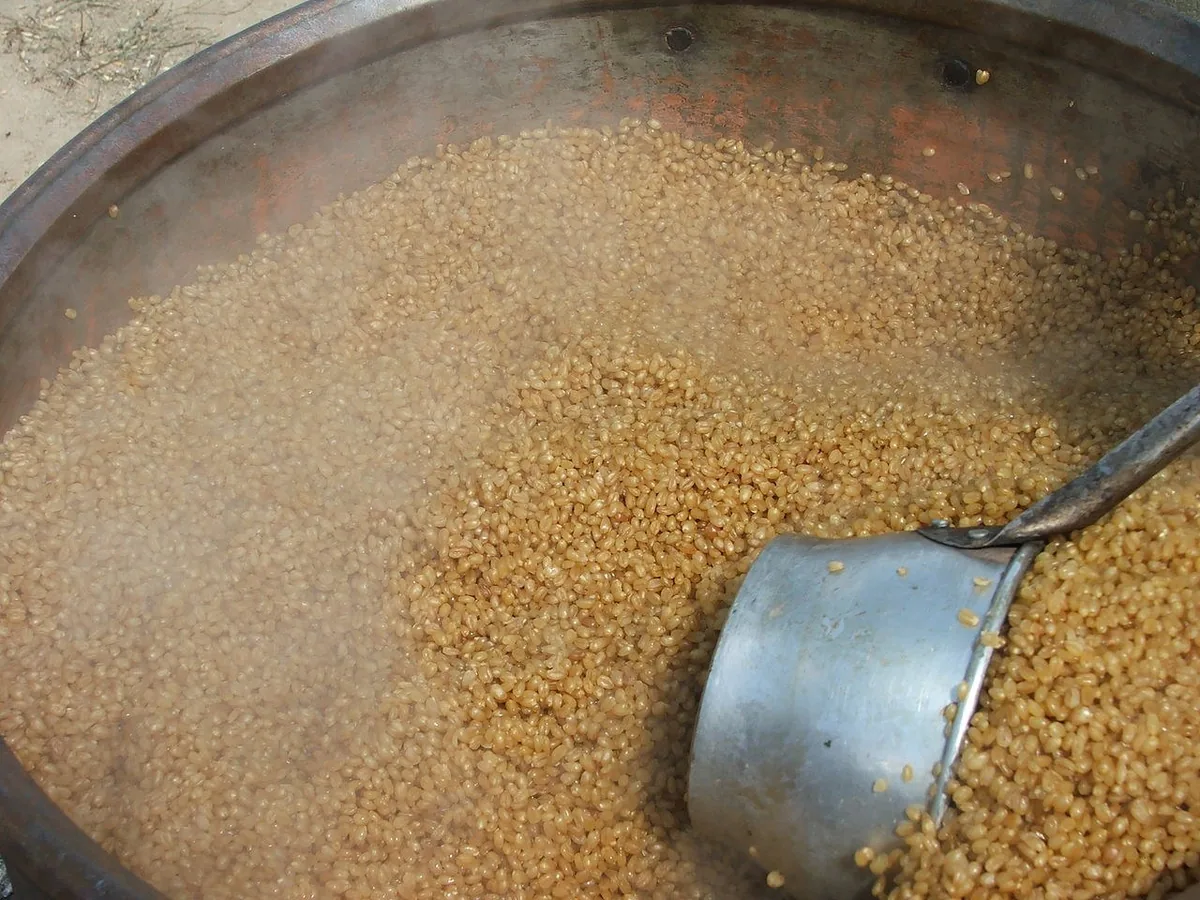
Bulgur is cracked wheat that is parboiled before drying. The dry grain has 342 kcal per 100 g, 12 g of protein and 12 g of fiber. When cooked, bulgur absorbs a lot of water, so 100 g of cooked bulgur has about 83 kcal. A 150 g side is 125 kcal, a 250 g plate 208. If you cook it thicker with less water, the number per 100 g gets closer to 100-110 kcal.
How much dry bulgur to use
A 150 g side takes about 37-40 g of dry grain, that is 127-137 kcal. A large plate takes 60-65 g. A 200 ml glass holds about 160 g of dry bulgur: 547 kcal and four servings. The most accurate way is to weigh the grain before cooking and multiply by 3.42: then it does not matter how much water it absorbed.
Bulgur with butter, tabbouleh and pilaf
A 10 g piece of butter turns a serving into 200 kcal. Tabbouleh, a Lebanese salad of bulgur, parsley, mint, tomatoes and olive oil, comes to about 120 kcal per 100 g, most of it from the oil. Bulgur pilaf with chicken is about the same as rice pilaf, 140-160 kcal per 100 g, but with much more fiber.
Bulgur, couscous and buckwheat
Bulgur and couscous are both made from wheat, but couscous is little pellets of semolina, while bulgur is cracked whole grain, so it has two to three times more fiber. In fullness bulgur is closer to buckwheat: 4.5 g of fiber per 100 g cooked against 2.7 for buckwheat and 0.4 for white rice. For weight loss it is a handy side: a light serving that keeps you full for a long time.
How to count your serving
Weigh the dry grain and multiply by 3.42 or the cooked one by 0.83, counting butter separately. If the bulgur is in a salad or with meat and vegetables, take a photo in MyFoodMate AI and the app splits the plate into foods.