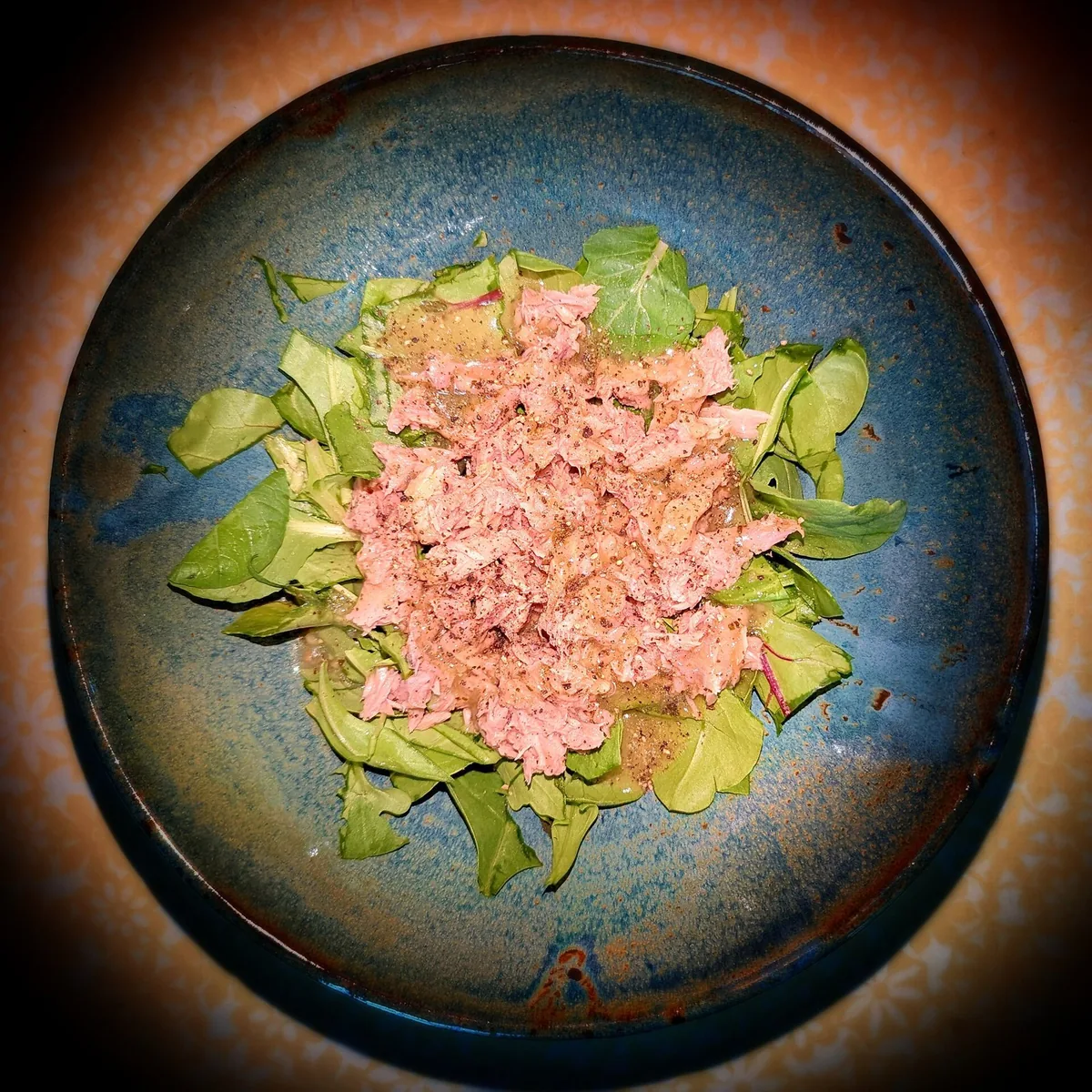
Calories per serving
| Serving | Kcal | P | F | C |
|---|---|---|---|---|
| Tablespoon, 20 g | 19 | 4.2 | 0.2 | 0.0 |
| 100 g | 96 | 21.0 | 1.0 | 0.0 |
| Can, drained, 130 g | 125 | 27.3 | 1.3 | 0.0 |
Your plate isn't the average one
The table shows average reference values. Take a photo of your plate: we will count the composition, macros and FoodMate Score of exactly your serving. Free, no sign-up, the photo is not stored.
Drop a food photo here
Or choose a file from your computer. A regular top-down photo of the plate in daylight works best.
FoodMate Score of the food
This is a score for the food on its own, by its composition per 100 g, using the same formula the app applies to a meal. On a plate with other foods the result will differ: buckwheat with vegetables scores higher than buckwheat alone.
How it changes with different cooking methods
| Version | Serving |
|---|---|
| In its own juice | 125 kcal |
| In oil, drained | 257 kcal |
| Salad: tuna, 2 eggs and a tablespoon of mayonnaise | 398 kcal |
Micronutrients
Values for a standard serving, as a percentage of the daily value for an adult.
| Nutrient | Per serving | % DV |
|---|---|---|
| Selenium | 104 mcg | 149% |
| Vitamin B12 | 3.2 mcg | 107% |
| Niacin (B3) | 16.9 mg | 84% |
| Vitamin D | 2.2 mcg | 15% |
How many calories are in canned tuna
Tuna in its own juice has about 96 kcal per 100 g: 21 g of protein and about a gram of fat. A standard 185 g can holds about 130 g of drained fish, that is 125 kcal and 27 g of protein. Brands differ, from 90 to 110 kcal, depending on the tuna species and which part of the fish fills the can. A tablespoon of tuna weighs about 20 g and gives 19 kcal.
In its own juice or in oil
Tuna in oil, even drained, comes to about 198 kcal per 100 g, twice as much as in its own juice: the fish soaks up the oil. If you eat the can with the oil, it is even more. For weight loss tuna in its own juice is handier, and if you want oil, add it to the salad yourself with a spoon, so you can see how much.
Tuna salad
A salad of a can of tuna, two eggs and a tablespoon of mayonnaise is about 398 kcal, a quarter of it from the mayonnaise. With cucumber, lettuce and a spoon of olive oil instead of mayonnaise it is about 330 kcal. Tuna with Greek yogurt instead of mayonnaise is the lightest version, about 320 kcal for the same salad, with over 40 g of protein.
Tuna on a diet
Canned tuna is ready-made protein that needs no cooking: a 125 kcal can covers half the daily protein of many people. It is rich in selenium and vitamin B12. The downsides are salt and, in large tuna species, possible mercury, so canned tuna is better eaten once or twice a week rather than every day.
How to count your serving
Drain the liquid, weigh the fish and multiply by 0.96 for tuna in juice or by 1.98 for tuna in oil. If the tuna is in a salad, pasta or sandwich, take a photo in MyFoodMate AI and the app counts everything together.