Calories per serving
| Serving | Kcal | P | F | C |
|---|---|---|---|---|
| Slice for a sandwich, 20 g | 42 | 4.1 | 2.7 | 0.0 |
| 100 g | 208 | 20.4 | 13.4 | 0.0 |
| Steak, 150 g | 312 | 30.6 | 20.1 | 0.0 |
| Large steak, 220 g | 458 | 44.9 | 29.5 | 0.0 |
Your plate isn't the average one
The table shows average reference values. Take a photo of your plate: we will count the composition, macros and FoodMate Score of exactly your serving. Free, no sign-up, the photo is not stored.
Drop a food photo here
Or choose a file from your computer. A regular top-down photo of the plate in daylight works best.
FoodMate Score of the food
This is a score for the food on its own, by its composition per 100 g, using the same formula the app applies to a meal. On a plate with other foods the result will differ: buckwheat with vegetables scores higher than buckwheat alone.
How it changes with different cooking methods
| Version | Serving |
|---|---|
| Raw, Atlantic | 312 kcal |
| Wild: coho, sockeye | 218 kcal |
| Baked without oil | 309 kcal |
| Lightly salted | 303 kcal |
| Cold-smoked | 300 kcal |
| Pan-fried in oil | 360 kcal |
Micronutrients
Values for a standard serving, as a percentage of the daily value for an adult.
| Nutrient | Per serving | % DV |
|---|---|---|
| Omega-3 | 3 g | 273% |
| Vitamin D | 16.5 mcg | 110% |
| Vitamin B12 | 4.8 mcg | 160% |
| Selenium | 36 mcg | 51% |
| Niacin (B3) | 12 mg | 60% |
How many calories are in 100 g of salmon
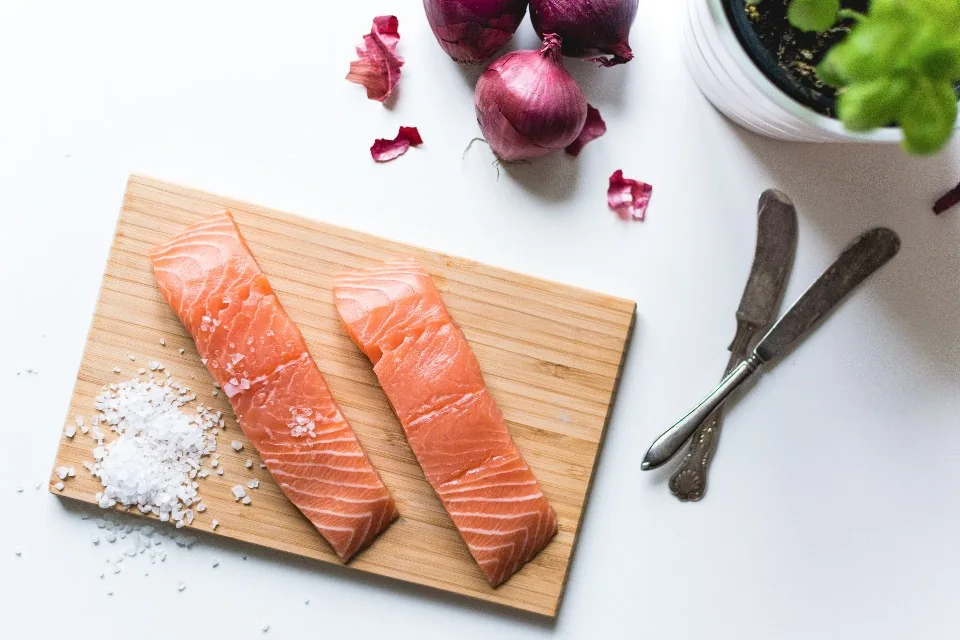
Atlantic salmon, often sold as semga in Russian stores, has 208 kcal per 100 g: 20.4 g of protein and 13.4 g of fat, no carbs. Almost all salmon on sale is farmed, and it is fattier than wild fish. A 150 g steak gives 312 kcal and 31 g of protein, a 20 g slice for a sandwich 42 kcal. The belly is fattier than the back: it can be 20-25% fat and reach 280 kcal.
Salted, smoked and baked
Salting and cold smoking barely change the calories: lightly salted and cold-smoked salmon are about 200 kcal per 100 g, but very salty. Baked fish loses water but also some fat, so a baked steak comes out almost like raw, about 206 kcal per 100 g. Pan-frying in oil adds 30-40 kcal per 100 g. Rolls and poke with salmon are counted together with the rice and sauce, and they have far more calories than the fish itself.
Wild and farmed salmon
Wild salmon species like coho, sockeye, pink and chum are leaner than farmed Atlantic salmon: 130-150 kcal per 100 g and half the fat. They have the same or even more protein. Farmed fish is fattier because of feed and little movement in the pens, but it also carries more omega-3 per serving. The difference shows in taste and price too: farmed salmon is softer, wild fish is drier and firmer.
Salmon for weight loss
Salmon has more calories than white fish, but they are good calories: a 150 g steak gives one and a half days of vitamin D, more than two days of omega-3 and a lot of protein. In a deficit it is handy to eat salmon once or twice a week instead of fattier meat. Count the sauces: a cream sauce easily adds another 150-200 kcal.
How to count your serving
Weigh the fish before cooking and multiply by 2.08, counting oil and sauce separately. If the salmon is in rolls, poke or a salad, take a photo in MyFoodMate AI: the app splits the plate into foods and logs the calories.