Calories per serving
| Serving | Kcal | P | F | C |
|---|---|---|---|---|
| Teaspoon, 5 g | 45 | 0.0 | 5.0 | 0.0 |
| Tablespoon, 15 g | 135 | 0.0 | 15.0 | 0.0 |
| 100 g | 899 | 0.0 | 99.9 | 0.0 |
Your plate isn't the average one
The table shows average reference values. Take a photo of your plate: we will count the composition, macros and FoodMate Score of exactly your serving. Free, no sign-up, the photo is not stored.
Drop a food photo here
Or choose a file from your computer. A regular top-down photo of the plate in daylight works best.
FoodMate Score of the food
This is a score for the food on its own, by its composition per 100 g, using the same formula the app applies to a meal. On a plate with other foods the result will differ: buckwheat with vegetables scores higher than buckwheat alone.
How it changes with different cooking methods
| Version | Serving |
|---|---|
| Refined | 135 kcal |
| Unrefined | 135 kcal |
Micronutrients
Values for a standard serving, as a percentage of the daily value for an adult.
| Nutrient | Per serving | % DV |
|---|---|---|
| Vitamin E | 6.2 mg | 41% |
How many calories are in a spoon of sunflower oil
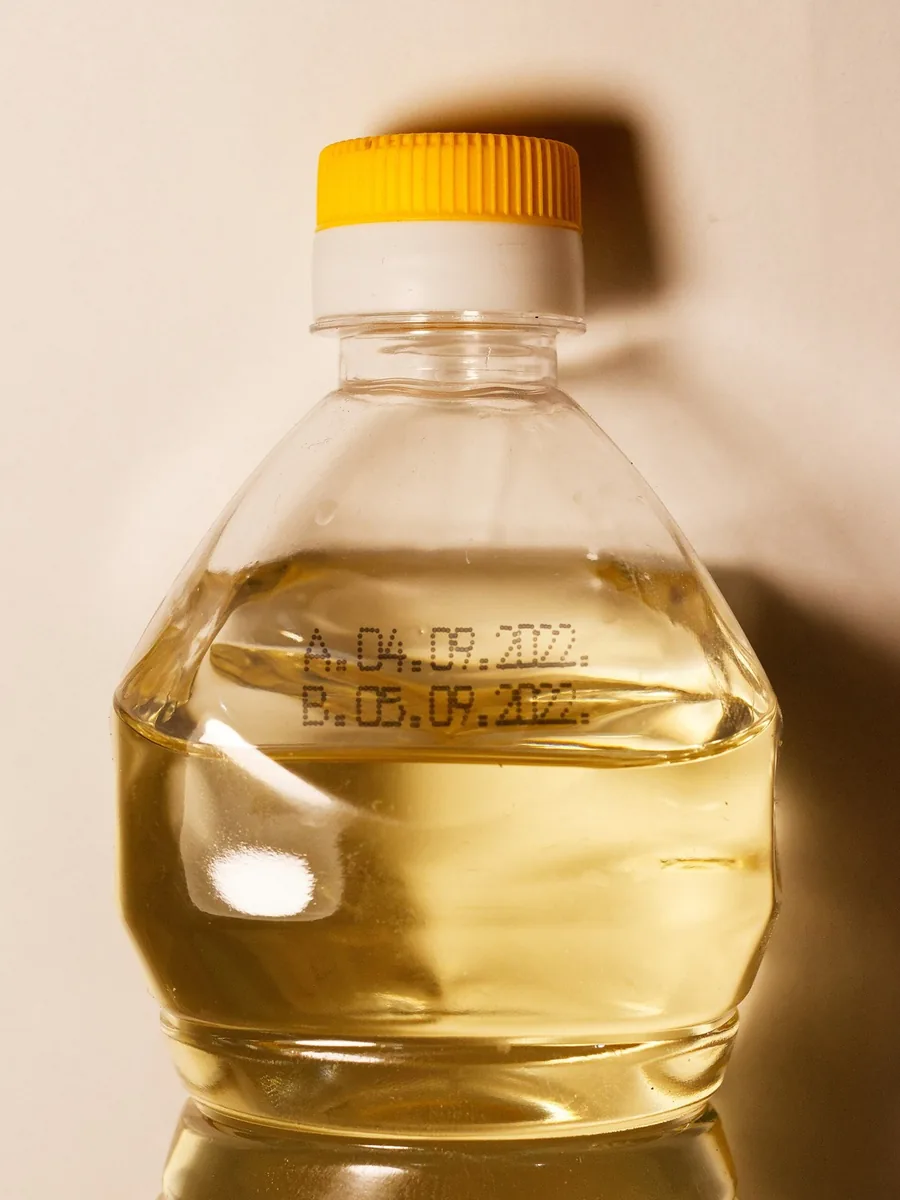
Sunflower oil is pure fat: 899 kcal per 100 g. A tablespoon holds about 15 g, that is 135 kcal, a teaspoon about 5 g and 45 kcal. Oil pours easily, so a splash in the pan from the bottle is often two or three tablespoons, 270-400 kcal before any food goes in.
How much oil is absorbed when frying
Some oil stays in the pan and some goes into the food. Meat and eggs absorb little, 10-20% of what you pour. Potatoes, onion and dough take more. Eggplant, zucchini and anything in flour or batter act as a sponge and take almost all the oil. For a food diary it is safest to assume all the poured oil was absorbed, especially with vegetables.
Refined and unrefined
There is no difference in calories. Unrefined oil smells of seeds and suits salads and vinaigrette, but smokes at high heat. Refined oil is neutral and handier for frying. Sunflower oil is rich in vitamin E: a tablespoon gives about 40% of the daily need. High-oleic sunflower oil is closer to olive oil in composition.
Oil for weight loss
Oil should not be cut out entirely: fat-soluble vitamins are poorly absorbed without it. But it is the most caloric food in the kitchen and the one most often left uncounted. Simple habits help: measure oil with a spoon, fry in a non-stick pan, and dress salads with a teaspoon rather than a tablespoon.
How to count your serving
Measure the oil with a spoon or weigh the bottle before and after and multiply the difference by 9. If the oil is already in a salad or a fried dish, take a photo in MyFoodMate AI and the app estimates it along with the food.