Contents
First, check: is it a plateau or just fluctuation
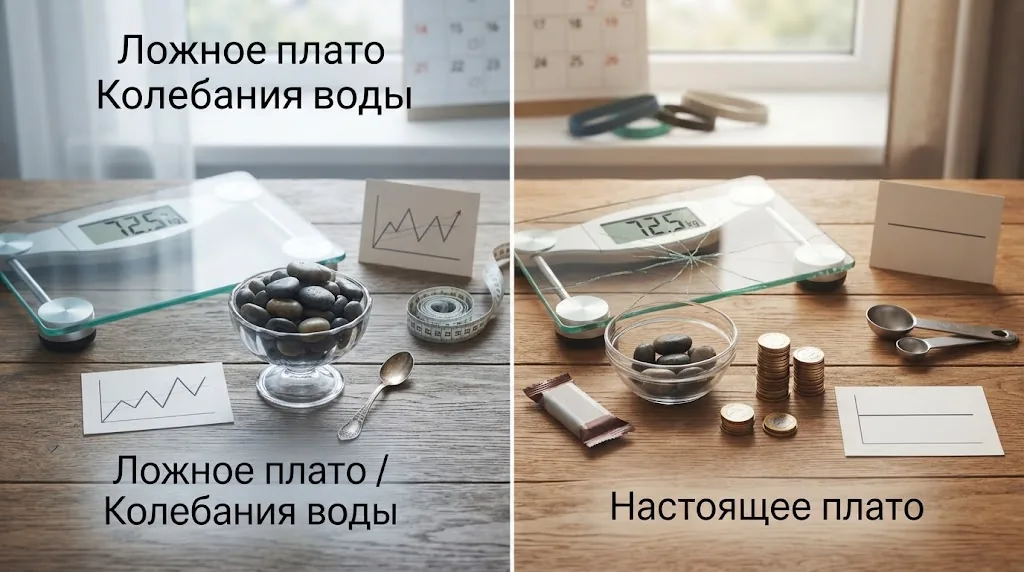
A week without change on the scale almost never means a plateau; it's just the ordinary life of a body that's 50-60% water. Within a day your weight can jump 1-2 kg up or down after a salty dinner, a workout, a bad night or because of your cycle, while a 400-500 kcal deficit takes off only 0.3-0.5 kg of fat a week, so a week of honest fat loss easily hides behind one evening of sushi. A plateau is when your average weight hasn't changed for two or three weeks in a row while you're counting honestly, and that means an average over several weeks, not one morning or one week.
To work it out, weigh yourself 3-7 times a week under the same conditions, in the morning on an empty stomach after the toilet and without clothes, add up the week's readings, divide by their number and compare this week's average with last week's. Here's what that looks like with real numbers:
| Week | Readings, kg | Average, kg |
|---|---|---|
| 1 | 78.4 · 78.1 · 78.9 · 78.2 · 77.8 | 78.3 |
| 2 | 78.6 · 77.9 · 78.0 · 78.5 · 77.6 | 78.1 |
| 3 | 77.4 · 78.2 · 77.7 · 77.5 · 77.9 | 77.7 |
Week two includes a reading of 78.6, higher than almost anything in week one, and if you only looked at single mornings you'd think the weight was going up. Yet the average fell by 0.6 kg over three weeks, which isn't a plateau but normal weight loss hiding behind the noise. In MyFoodMate AI the weight tracker plots every reading, and the Progress screen shows how the picture changes over 7, 30 and 90 days; how to read it is explained in the guides Weekly averages and Weight log.
The weight is stuck but you're getting smaller
This is one of the most common situations and, honestly, one of the best, though people somehow take it as failure: the scale shows the same number for the third week while your jeans do up more easily and your waist has shrunk. It most often happens when someone starts training, because muscles hold water to recover after a new kind of load, sometimes 1-2 kg, so fat goes out, water comes in and the scale stands still until the body adapts three or four weeks later and the water leaves. Beginners in the weight room can also put on a little muscle in the first months even in a deficit, though that's small, 0.5-1 kg a month at best. And many women hold 1-2 kg of water in the week before their period while their measurements keep going down.
That's why it's worth measuring your waist once a week as well, in the morning on an empty stomach, at navel level, breathing out. If your waist is shrinking while your weight stands still, you're losing fat, and the tape measure is more honest than the scale.
Why energy use falls along with your weight
If your average weight and waist really haven't changed for three weeks, it's a true plateau, and the main reason is simple arithmetic. You're lighter, so your body needs less energy: someone at 75 kg has less to carry and less tissue to maintain than the same person at 85 kg, so a deficit of 500 kcal at 85 kg may shrink to 200-250 kcal at 75 kg, and to nothing if you've also started moving less. Kevin Hall of the US National Institutes of Health calculated that every kilogram lost lowers energy use by about 20-25 kcal a day, so losing 10 kg takes 200-250 kcal out of your deficit.
Adaptation is the second reason. Back in 1999 James Levine at the Mayo Clinic overfed volunteers by 1,000 kcal a day for two months and noticed that some of them hardly gained at all, because without realising it they got up, paced and fidgeted more, while others stored nearly every extra calorie. In a deficit the same mechanism works in reverse: you move a little less, sit a little longer, and those small savings add up to another 100-200 kcal. That's a normal response rather than a "broken metabolism", and you can win part of it back simply by watching your step count.
The third reason is the most common of all, and it's that the counting has slowly loosened. In the first month almost everyone measures oil with a spoon and logs every mandarin segment, but by the third month they're estimating by eye, forgetting the cheese "with coffee" and Friday's pizza, so more calories creep in while it feels as if nothing has changed.
Checking your counting
So before cutting food, spend a week eating the way you did in that first month and check what you really eat. "A drop of oil in the pan" usually turns out to be two tablespoons, or 270 kcal, once you measure it. Lattes, juice, a glass of wine and soda all count and belong in the diary alongside food. Weekends can't be skipped either, because when the weekday diary is perfect and Saturday and Sunday are blank, that's nearly always where the plateau hides. A handful of nuts at the desk is 180 kcal, two biscuits with tea 120-150, and familiar portions quietly grow over six months, so put them back on the scales. A detailed list of what most often slips out of the count is in Why am I not losing weight: 7 reasons.
What to change, in order
If your counting is honest and the plateau is real, change one thing at a time, from simple to hard, or you won't know what worked. The simplest and most often forgotten step is recalculating your target for your new weight: if you've lost 5 kg or more since you started, enter the new weight in the calculator, and it may well turn out 100-200 kcal lower, which alone explains the plateau. The gentlest way to restore the deficit is steps, since three thousand extra steps a day give 100-150 kcal and need neither willpower nor hunger. If that's not enough, cut another 100-200 kcal, no more, ideally from things that bring lots of calories and little fullness, like oil, sweet drinks and snacks. Keep protein at no less than 1.2 g per kilogram of body weight, since it fills you up and helps keep muscle, as covered in How much protein you need a day.
If you've been losing weight for more than three or four months straight and you're worn out, sometimes the best move is a week or two at maintenance with no deficit, after which the hunger eases and your energy returns, and your weight won't rise as long as you eat to your target rather than "letting go". After any change give your body two or three weeks, because deciding something new every three days is a sure path to chaos. If you keep your diary in MyFoodMate AI and weigh yourself regularly, after a few weeks the app compares how much you ate on average with how your weight changed, works out your real energy use and, if it differs from the formula by more than 8%, suggests updating your target on the Progress screen, as described in the guide Recalculating your target.
What not to do
A plateau at 1,500 kcal isn't cured by dropping to 800, which leads to muscle loss, binges and an even deeper plateau. Two hours of cardio a day won't help either, as it's exhausting, often ends in injury and ramps up appetite. There's no need to weigh yourself five times a day, which only adds anxiety, and there's no magic food: neither ginger, nor green tea, nor apple cider vinegar has shifted a plateau in real studies.
When to see a doctor
An ordinary plateau is physics and fatigue, not illness, but sometimes the cause is medical. If your weight has been stuck for more than two months despite honest counting checked with a week's audit, or you've noticed weakness, feeling cold, sleepiness, hair loss and dry skin, it's worth checking your thyroid. Women with irregular periods, acne and facial hair growth should get checked for polycystic ovary syndrome. It's also worth seeing a doctor if you take medicines that can affect weight, such as some antidepressants, hormonal drugs, glucocorticoids or diabetes medication, or if you've developed swollen legs and shortness of breath, since the weight gain may then be water, which is a symptom in itself. How to tell swelling from fat and why your weight jumps in the morning is something we'll cover separately.
Sources
- Hall KD et al. Quantification of the effect of energy imbalance on bodyweight. The Lancet, 2011.
- Rosenbaum M, Leibel RL. Adaptive thermogenesis in humans. International Journal of Obesity, 2010.
- Levine JA, Eberhardt NL, Jensen MD. Role of nonexercise activity thermogenesis in resistance to fat gain in humans. Science, 1999.

We check blog materials against current WHO recommendations.