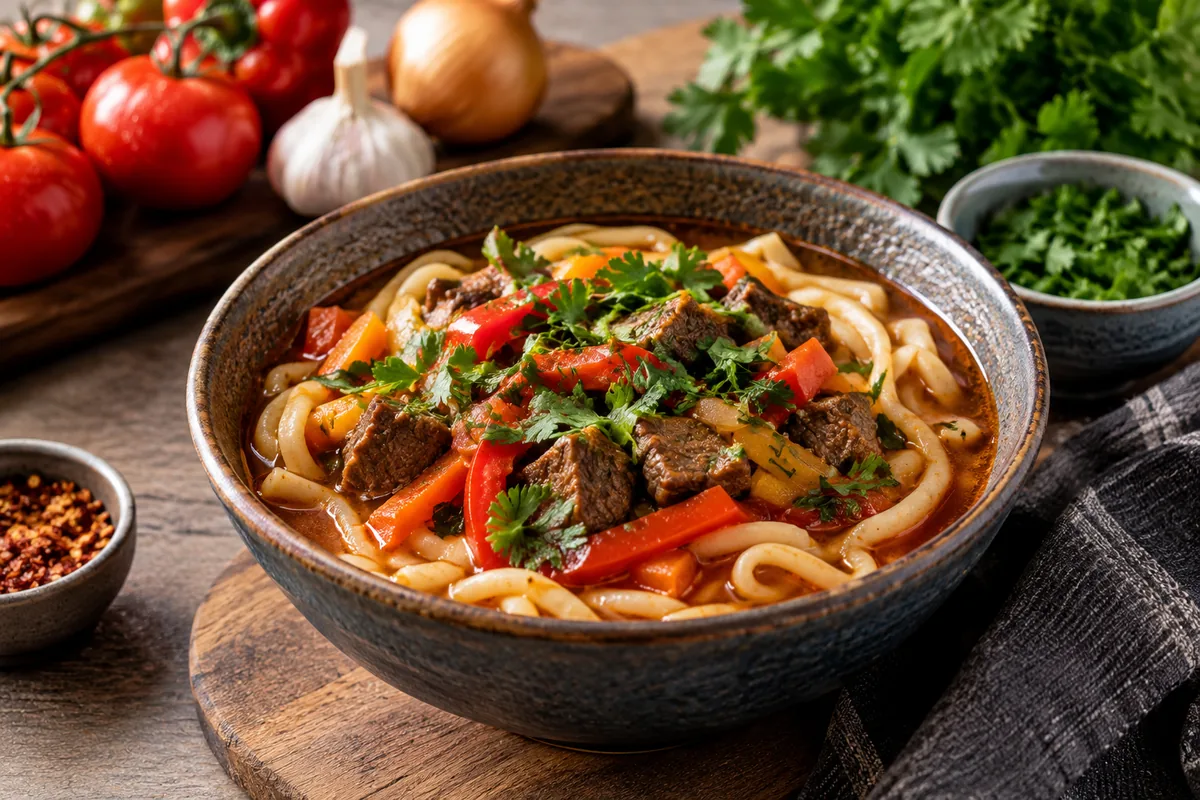
Calories per serving
| Serving | Kcal | P | F | C |
|---|---|---|---|---|
| 100 g | 135 | 7.2 | 5.2 | 15.0 |
| Small serving, 300 g | 405 | 21.6 | 15.6 | 45.0 |
| Serving, 400 g | 540 | 28.8 | 20.8 | 60.0 |
| Large serving, 500 g | 675 | 36.0 | 26.0 | 75.0 |
Your plate isn't the average one
The table shows an average recipe. Take a photo of your serving: we'll work out the ingredients, macros and FoodMate Score of exactly that plate. Free, no sign-up, the photo isn't stored.
Drop a food photo here
Or choose a file from your computer. A regular top-down photo of the plate in daylight works best.
Ingredients and how we count
We break the dish down by ingredient instead of taking an average “by name”. Below is a typical 410 g serving.
| Ingredient | Weight | Kcal |
|---|---|---|
| Boiled pulled noodles | 180 g | 250 |
| Braised beef | 70 g | 160 |
| Peppers, tomatoes, onion, carrot | 110 g | 40 |
| Vegetable oil | 10 g | 90 |
| Broth in the sauce | 40 g | 4 |
FoodMate Score of the dish
How it changes with different cooking methods
| Version | Serving |
|---|---|
| Uyghur-style with beef | 540 kcal |
| Lagman soup, 400 g | 300 kcal |
| With chicken | 480 kcal |
| With lamb | 600 kcal |
| Fried lagman (guiru) | 680 kcal |
Micronutrients
Values for a standard serving, as a percentage of the daily value for an adult.
| Nutrient | Per serving | % DV |
|---|---|---|
| Vitamin C | 30 mg | 33% |
| Vitamin A | 280 mcg | 31% |
| Iron | 3.4 mg | 24% |
| Zinc | 3.9 mg | 35% |
| Vitamin B12 | 1.6 mcg | 67% |
How many calories are in lagman
100 g of beef lagman contain about 135 kcal: 7.2 g of protein, 5.2 g of fat and 15 g of carbs. A 400 g restaurant-style serving gives 540 kcal, about 27% of a 2,000 kcal day. The noodles bring the most calories, nearly half of the dish's energy.
Lagman, lagman soup and guiru
In Central Asia several dishes are called lagman. Uyghur lagman is noodles with a thick sauce, as in our table. Lagman soup, popular in Uzbekistan, is thinner: more broth and fewer noodles, so it is about 240 kcal lighter. Guiru lagman is stir-fried in a wok together with the noodles and is the richest of the three.
Why lagman is a good meal
Lagman is rich in vegetables: bell peppers, tomatoes, carrots, radish and garlic provide vitamins A and C and fiber. Beef brings protein, iron and zinc. The weak points are refined noodles and oil, which is often used generously. At home, cut the oil to a spoon per serving and add more vegetables.
Lagman on a diet
A 540 kcal serving of lagman is a full lunch that doesn't need a snack afterwards. In a calorie deficit, choose a small serving or lagman soup and skip the bread. Ask the café for more vegetables and meat and fewer noodles - the calories go down while the fullness stays.
How to count your portion
The ratio of noodles, meat and sauce in lagman depends heavily on the cook, so 135 kcal per 100 g is a guide. Take a photo of your plate in MyFoodMate AI: the app estimates the noodles, meat and vegetables separately and calculates the macros.