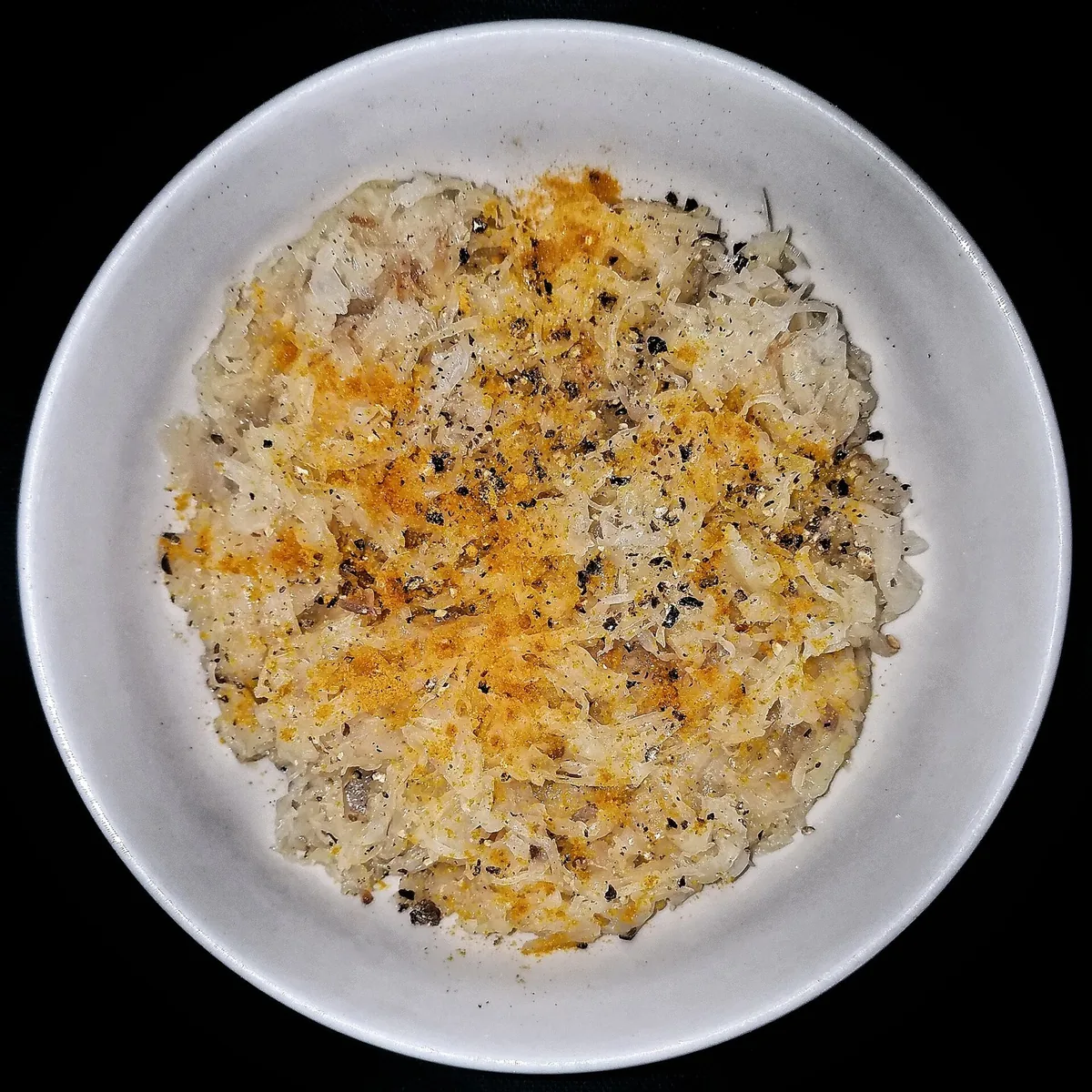
Calories per serving
| Serving | Kcal | P | F | C |
|---|---|---|---|---|
| Tablespoon, 30 g | 7 | 0.5 | 0.0 | 0.9 |
| 100 g | 23 | 1.8 | 0.1 | 3.0 |
| Salad serving, 150 g | 35 | 2.7 | 0.2 | 4.5 |
| 0.5 l jar, 450 g | 104 | 8.1 | 0.5 | 13.5 |
Your plate isn't the average one
The table shows average reference values. Take a photo of your plate: we will count the composition, macros and FoodMate Score of exactly your serving. Free, no sign-up, the photo is not stored.
Drop a food photo here
Or choose a file from your computer. A regular top-down photo of the plate in daylight works best.
FoodMate Score of the food
This is a score for the food on its own, by its composition per 100 g, using the same formula the app applies to a meal. On a plate with other foods the result will differ: buckwheat with vegetables scores higher than buckwheat alone.
How it changes with different cooking methods
| Version | Serving |
|---|---|
| Sauerkraut | 34 kcal |
| With carrots | 38 kcal |
| With a tablespoon of sunflower oil | 170 kcal |
| With oil, onion and cranberries | 185 kcal |
| Braised in oil | 90 kcal |
| Sauerkraut shchi with meat, 300 g bowl | 135 kcal |
Micronutrients
Values for a standard serving, as a percentage of the daily value for an adult.
| Nutrient | Per serving | % DV |
|---|---|---|
| Vitamin C | 30 mg | 30% |
| Vitamin K | 19.5 mcg | 16% |
| Potassium | 255 mg | 7% |
How many calories are in sauerkraut
Sauerkraut is one of the lightest foods on the table: 23 kcal per 100 g, 1.8 g of protein, 3 g of carbs and 2 g of fiber. During fermentation lactic acid bacteria eat some of the cabbage sugars, so it is even lighter than fresh cabbage. A tablespoon weighs about 30 g and gives 7 kcal, a 150 g salad serving 35, a half-liter jar 104 kcal.
Sauerkraut with oil, carrots and onion
Carrots barely change the calories: sauerkraut with carrots is about 25 kcal per 100 g. It is all about the oil. A tablespoon of sunflower oil (15 g) is 135 kcal, and a salad serving becomes 170 kcal, so 80% of the calories on the plate come from the oil. With onion and cranberries it is about 185. For less, use a teaspoon of oil per serving: 45 kcal, and the taste barely suffers.
Braised sauerkraut and shchi
Braised sauerkraut comes to about 60 kcal per 100 g: the oil used for braising adds the calories. With meat or sausages it is 100-150. Sour shchi soup with meat is about 45 kcal per 100 g, a 300 g bowl comes to 135 kcal, and a spoon of sour cream adds another 40.
What sauerkraut is good for
Sauerkraut is a good winter source of vitamin C: a serving gives about a third of the daily need, though long storage reduces it. It has fiber and lactic acid bacteria, if the cabbage was not pasteurized. The downside is salt: 100 g can have up to 1.5-2 g, so with high blood pressure it is better to rinse it. For weight loss it is a handy bulky side with almost no calories.
How to count your serving
Count the sauerkraut itself at 7 kcal per spoon, and weigh or measure the oil with a spoon. If the sauerkraut is on a plate with potatoes and meat, take a photo in MyFoodMate AI: the app counts the calories of the whole meal.